
What Justin Welsh, Lara Acosta, and Other Top Creators Do Differently on LinkedIn
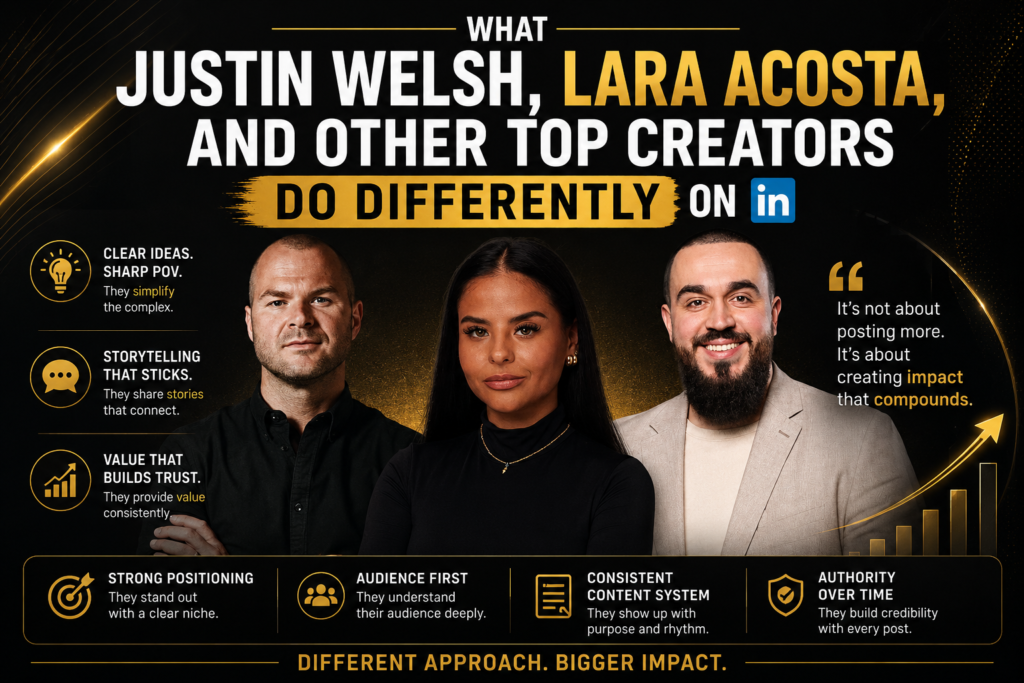
Fewer than 1% of LinkedIn’s members post content on a regular basis, yet that sliver of the platform generates roughly 9 billion impressions and shapes what the rest of the network sees, shares, and believes (LiGo Social, 2025). Justin Welsh turned that small window of opportunity into a business worth more than $10 million, built almost entirely on LinkedIn posts and a single newsletter (Autoposting.ai, 2026). Lara Acosta went from being unemployed with $500 in savings to becoming the platform’s top-ranked female creator in under two years (Meet-Léa, 2026).
Neither of them got there by posting whenever inspiration struck. Their growth followed patterns that repeat across nearly every creator who breaks out on LinkedIn: a narrow focus, a repeatable system, an obsession with comments, and a plan to own their audience beyond the platform. This article breaks down what the data and their own public playbooks reveal about how top LinkedIn creators actually operate, and how professionals and business owners can apply the same principles without needing 500,000 followers to start.
1. They Pick One Problem and Refuse to Wander
The single biggest difference between top LinkedIn creators and everyone else is not talent or luck; it is restraint. Justin Welsh has described his entire content philosophy in one sentence: solve one expensive problem, repeatedly. For him, that problem is how professionals build attention or revenue on their own, and nearly every post he writes connects back to it in some way (Autoposting.ai, 2026).
Lara Acosta applies the same discipline through what she calls her unfair advantage: the specific combination of background, experience, and perspective that no competitor can copy exactly. Rather than covering every trend in marketing or branding, she stays inside a clearly defined lane focused on personal brand strategy (Autoposting.ai, 2026; Clary, 2024).
Why Niching Down Still Wins in a Crowded Feed
This focus matters because the LinkedIn content landscape is more crowded and more specialized than most creators assume. Among the platform’s top 100 B2B creators, image posts make up 44% of published content, followed by video at 28% and plain text at 20%, and business and entrepreneurship remains the single largest content category among active creators (The Influencer Marketing Factory, 2025). Standing out inside that volume requires a recognizable point of view, not broader coverage.
2. They Turn Consistency Into a Non-Negotiable System
Consistency is the advice every LinkedIn guide repeats, but top creators treat it as an operational rule rather than a vague intention. Lara Acosta commits to three posts per week without exception, a cadence she frames as non-negotiable because irregular posting causes reach to decline on the platform’s algorithm (Meet-Léa, 2026). Justin Welsh has historically gone further, publishing twice daily at fixed times, 8:15 a.m. and 1:05 p.m. Eastern, so his audience learns exactly when to expect him (Welsh, 2023).
Both creators build content in batches rather than scrambling for ideas each morning. Welsh has publicly described weekend sessions where a single long-form piece gets broken into a week’s worth of posts across formats and platforms, turning one idea into more than a dozen usable pieces of content (Welsh, 2023).
The Data Behind the Habit
This system-first approach is backed by measurable results. An analysis of 100 top-performing LinkedIn influencers found that only 20% post at least once per day, meaning the creators who do commit to daily publishing separate themselves from the majority of active accounts (Copyblogger, 2025). Separately, posting on a consistent weekly schedule has been shown to double engagement compared to sporadic posting (LiGo Social, 2025).
3. They Treat Comments as a Growth Channel, Not a Courtesy
Most professionals think of commenting as a polite afterthought. Top creators treat it as a deliberate distribution strategy. Justin Welsh recommends leaving five to ten thoughtful, substantive comments on relevant posts every day, explicitly warning that generic agreement does not count, and he sets a personal goal of engaging six to eight new people in his niche each week (Welsh, 2024).
Lara Acosta’s own growth story includes a similar, less-publicized lever: a significant share of her early audience came from active commenting on other creators’ posts rather than from her own publishing alone. A single well-placed comment on a viral post can expose a name to thousands of people who have never encountered that creator before (Meet-Léa, 2026).
This behavior lines up with how the platform actually rewards content. Personal profiles on LinkedIn generate roughly eight times more engagement than identical content published from a company page, and that gap has been widening rather than closing (Digital Applied, 2026). Commenting as a real person, under a real profile, taps directly into that advantage in a way brand accounts cannot replicate.
4. They Build an Owned Audience Instead of Renting Attention
Every top LinkedIn creator eventually faces the same risk: the platform, not the creator, controls the algorithm, the feed, and the rules. Justin Welsh addresses this by including a link to his own website or newsletter in nearly every post, often editing it in after the post has already been scored by the algorithm to avoid the reach penalty LinkedIn applies to off-platform links (Spector, 2024). His newsletter, The Saturday Solopreneur, has grown past 200,000 subscribers, giving him a channel that no algorithm change can take away (Autoposting.ai, 2026).
This owned-audience strategy is increasingly common among serious creators, and the platform itself has responded to the trend. LinkedIn newsletters grew 150% year over year and now reach roughly 45 million subscribers across the platform, showing that audience-owning behavior is becoming a mainstream part of how top creators operate rather than a niche tactic (Digital Applied, 2026).
Thought Leadership Compounds Trust
The payoff for this approach goes beyond follower counts. In the 2025 Edelman-LinkedIn B2B Thought Leadership Impact Report, 53% of B2B decision-makers said that when a company’s thought leadership is strong, brand recognition matters less in their purchasing decisions (Edelman & LinkedIn, 2025). In other words, a smaller but consistently visible voice can compete with much larger, better-known competitors purely through the quality and regularity of its content.
5. They Monetize in Parallel With Growth, Not After It
A common misconception is that creators wait to hit a follower milestone before building an offer. Lara Acosta did the opposite: she founded her personal branding agency, LA Digital, while her following was still growing, treating the business and the audience as two tracks developing at the same time rather than sequential steps (Meet-Léa, 2026).
This mirrors a broader shift in how brands and professionals now approach LinkedIn. More than half of B2B marketers, 55%, already use creator or influencer marketing on the platform, and another 29% plan to adopt it within the next year (LinkedIn/Ipsos, 2025). Brands that invest in creator partnerships report engagement and awareness gains of up to 39% and revenue or lead-generation gains of up to 30% compared to brands that do not (LinkedIn/Ipsos, 2025).
The demand for this kind of personal, creator-led presence is not limited to marketing departments. Among Gen Z adults, 67% say having a strong personal brand is important to their career, and many are building that presence on LinkedIn well before they enter full-time roles (Forbes, 2025). The behaviors modeled by Welsh and Acosta are no longer optional extras for a handful of influencers; they are becoming the baseline expectation for anyone serious about LinkedIn visibility in their field.
Key Takeaways and Your Next Step
The creators who break out on LinkedIn are not the ones with the most polished writing or the biggest initial network. They are the ones who pick a narrow problem and stay on it, turn posting into a repeatable system rather than a mood, treat comments as active distribution, build an audience they own outside the platform, and start monetizing early instead of waiting for permission.
● Narrow your focus to one problem you can speak on with authority every week.
● Set a fixed, sustainable posting cadence and batch content instead of writing from scratch daily.
● Spend real time commenting thoughtfully on other people’s posts, not just publishing your own.
● Give people a reason and a link to follow you somewhere you control, like a newsletter or website.
● Start building your offer or audience-owned channel now, alongside your growth, not after it.
You do not need 500,000 followers to start applying any of these five patterns. Pick the one that feels most uncomfortable right now, whether that is committing to a posting schedule or finally writing that first newsletter issue, and treat it as this week’s experiment. That single habit, repeated consistently, is exactly how Justin Welsh, Lara Acosta, and every other creator on this list actually got started.