
The 7 Pillars of Personal Branding: A Complete Guide for Professionals
More than 90 percent of professionals believe that developing a personal brand meaningfully affects a manager’s career success and competitiveness in the job market (Forbes, 2024). Yet most people still treat personal branding as a vague idea rather than a skill they can build deliberately. That gap between how much it matters and how few people actually work on it is where the opportunity lies.
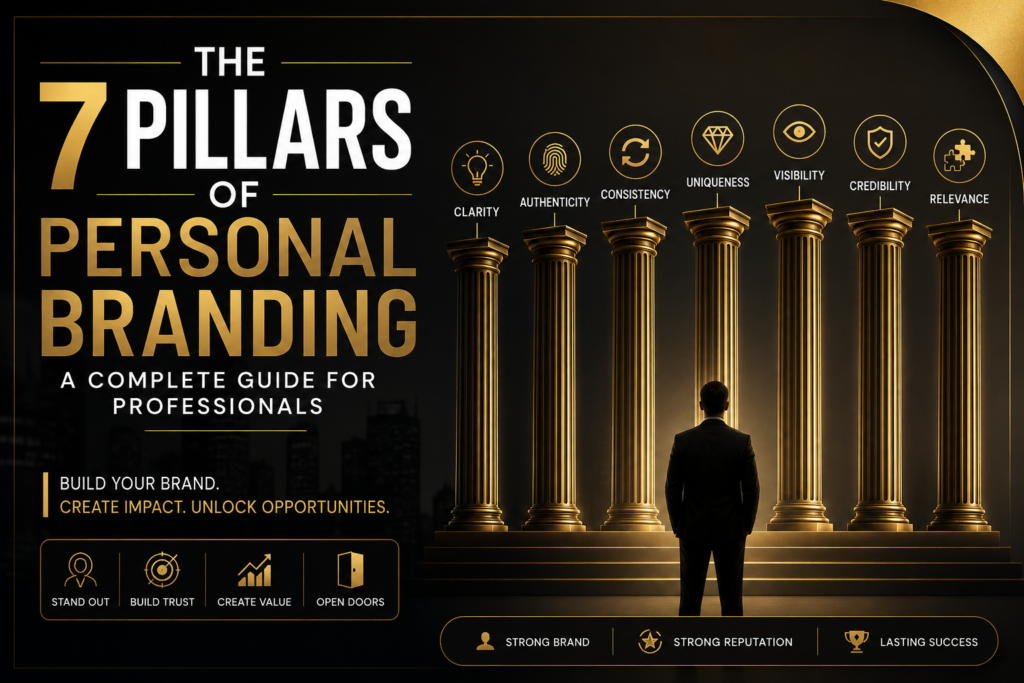
A personal brand is not a logo or a tagline. It is the sum of how colleagues, clients, and recruiters perceive your expertise, your values, and your reliability, whether they meet you in a boardroom or scroll past your LinkedIn post at midnight. Search “pillars of personal branding” and you will find a widely cited seven-part framework: clarity, authenticity, consistency, uniqueness, visibility, credibility, and relevance. This guide breaks down what each pillar means in practice, why the research supports it, and how to start strengthening it this week.
Why Personal Branding Has Become a Career Essential
Personal branding is not just a feel-good exercise. A peer-reviewed study published in Frontiers in Psychology found that personal branding behaviors are positively linked to career satisfaction, an effect fully explained by how employable people feel as a result (Gorbatov et al., 2019). In other words, actively shaping how others perceive you is not vanity; it changes how capable and hireable you actually feel.
Employers are watching too. A CareerBuilder survey found that 70 percent of employers use social networking sites to research candidates before making hiring decisions (CareerBuilder, as cited in Hazeltine Executive Search, 2024). With AI tools now reshaping how work gets done and evaluated, Forbes contributor William Arruda argues that a clearly defined personal brand has become one of the few durable differentiators professionals still control (Forbes, 2025). The seven pillars below give that differentiation some structure.
Pillars 1 and 2: Clarity and Authenticity
Clarity: Know What You Stand For
Clarity means being able to explain, in a sentence or two, what you do, who you help, and what makes your approach different. Without it, every other pillar collapses, because visibility and consistency only work if there is something specific to be visible and consistent about. Start by writing down the three skills or outcomes you most want to be known for, then test whether a colleague could repeat them back to you after one conversation.
Authenticity: Be Real, Not Rehearsed
Authenticity is what separates a personal brand people trust from one they scroll past. As LinkedIn creator manager Cayman Rojas puts it in Harvard Business School Online’s personal branding course, authenticity is what creates the trust that allows a community to actually support you (Harvard Business School Online, 2025). This matters even more for managers specifically: the same Forbes-reported study found that professionals see personal branding as directly tied to a manager’s real-world success, not just their online presence (Forbes, 2024). Authenticity is not oversharing; it is letting your actual expertise and working style show through, rather than performing a version of yourself borrowed from someone else’s feed.
Putting clarity and authenticity into practice looks like this:
● Write a one-line positioning statement and test it on a colleague before publishing it anywhere.
● Replace generic descriptors such as “passionate” or “results-driven” with one concrete example that proves the claim.
● Write your About section or bio in the same voice you use in meetings, not a stiffer, more formal one.
Pillars 3 and 4: Consistency and Uniqueness
Consistency Builds Trust Over Time
Consistency is what turns a one-time impression into a reputation. Research from Lucidpress’s State of Brand Consistency study found that organizations presenting themselves consistently across channels saw revenue increase by as much as 33 percent compared with those that did not (Lucidpress, 2019). The same logic applies to individuals: a headline that contradicts your About section, or a posting pattern that goes silent for months at a time, forces people to keep re-evaluating who you are instead of simply trusting what they already know.
Uniqueness Sets You Apart
Uniqueness is the pillar most people skip because it feels uncomfortable to claim. It does not require inventing a persona. It means naming the specific intersection of skills, industries, or perspectives that few other people in your field combine, and then repeating that positioning often enough that it becomes associated with your name rather than a generic job title.
A few ways to strengthen both pillars at once:
● Audit your last ten posts or presentations for a repeated theme, phrase, or framework; consistency often already exists and simply needs naming.
● Pick two or three fields you can credibly connect, such as operations and sustainability, and let that combination become your recognizable angle.
● Reuse the same headline structure, tone, and sign-off across LinkedIn, email signatures, and your resume so each touchpoint reinforces the others.
Pillars 5 and 6: Visibility and Credibility
Visibility: Show Up Where It Counts
Visibility is not about posting constantly; it is about being findable when it matters. LinkedIn data shows that users with fully completed profiles are 40 times more likely to receive opportunities through the platform (LinkedIn, as cited in Botdog, 2025). Given that most employers now research candidates online before ever speaking with them, an incomplete or outdated profile is effectively an invisible one, regardless of how strong the underlying expertise is.
Credibility: Earn the Benefit of the Doubt
Credibility is visibility’s payoff. Edelman and LinkedIn’s B2B thought leadership research found that seven in ten decision-makers think more positively about organizations that consistently produce high-quality thought leadership content (Edelman-LinkedIn, as cited in Human to Brand, 2025). For individuals, the same pattern holds: sharing well-reasoned, specific insights repeatedly does more for credibility than a single polished credential ever could, because it demonstrates ongoing judgment rather than a one-time achievement.
To strengthen visibility and credibility together:
● Complete every section of your LinkedIn profile, including a custom URL, banner, and Featured section, rather than leaving the default template in place.
● Publish one substantive insight a week instead of ten shallow ones a day; specificity earns more trust than frequency alone.
● Ask for and display evidence of impact, such as a client outcome, a metric, or a direct quote, rather than relying on self-description.
Pillar 7: Relevance, and Bringing the Framework Together
Relevance is the pillar that keeps the other six from going stale. A personal brand built around skills or platforms that mattered five years ago will not carry the same weight today. Forbes’ 2026 personal branding coverage points to how quickly the landscape is shifting as AI reshapes how professionals are discovered and evaluated, making it more important than ever to revisit and update how you present your expertise (Forbes, 2025). Relevance means periodically asking whether the story you are telling about yourself still matches what your industry currently values.
● Set a recurring reminder, quarterly is reasonable, to reread your own profile as a stranger would.
● Retire language, tools, or achievements that no longer reflect your current level of skill or focus.
● Follow what your target audience is actually discussing now, not what was trending when you first wrote your bio.
Together, the seven pillars work in sequence rather than in isolation. Clarity gives you something specific to say. Authenticity makes it believable. Consistency and uniqueness make it memorable. Visibility and credibility make it findable and trusted. Relevance keeps the whole structure from becoming outdated. Weakness in any single pillar tends to undercut the others, which is why a scattered LinkedIn profile or an inconsistent posting habit can quietly erode even genuinely strong expertise.
Key Takeaways and Next Steps
A strong personal brand is not built overnight, but it is built predictably: define what you stand for, show up as yourself, stay consistent, claim what makes you different, be visible where your audience already looks, earn trust through repeated value, and keep the whole picture current. Professionals who treat these seven pillars as a working checklist, rather than a one-time branding exercise, are the ones who compound their reputation year over year instead of starting from zero each time.
Ready to put this into practice? Start with one pillar this week, most people find clarity or visibility the fastest to fix, and revisit your profile, portfolio, or LinkedIn presence with fresh eyes before moving on to the next.