
Local SEO Strategies Every Business Should Know
Introduction
Struggling to show up in local search? These local SEO strategies help small businesses rank higher, attract nearby customers, and grow.
If someone nearby searches “best [your service] near me” right now, does your business show up? For a huge number of small business owners, the honest answer is no and that’s real customers walking straight to a competitor instead.
That’s exactly the gap that local SEO strategies are built to close. Local SEO is the practice of optimizing your online presence so your business shows up in front of nearby customers at the exact moment they’re searching for what you offer and whether that’s on Google Maps, the local “Map Pack,” or a basic search results page.
Many business owners have already tried general SEO advice a few blog posts, a redesigned homepage and seen little movement in local rankings. That’s because local search runs on a different set of signals than national SEO, and most generic advice never touches them.
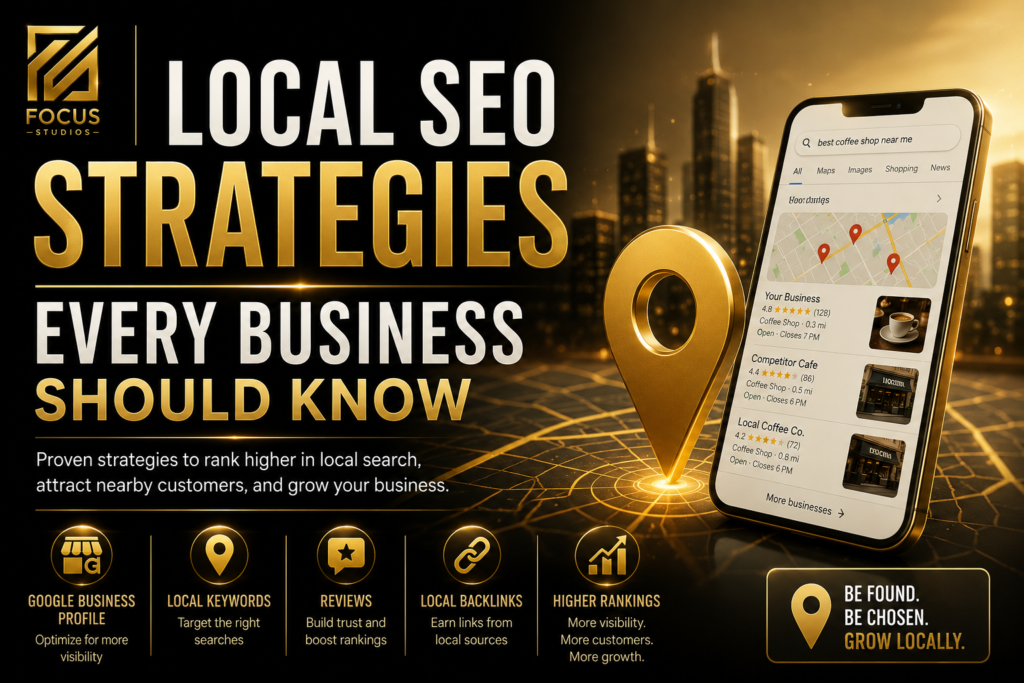
Below is a practical walkthrough of the local SEO strategies that actually move the needle: optimizing your Google Business Profile, fixing citation and NAP issues, choosing the right local keywords, earning reviews, building local backlinks, and the common mistakes that quietly sabotage all of it.
What Is Local SEO and Why It Matters for Your Business
Local SEO is the process of improving your visibility in location-based search results, primarily Google’s Map Pack and local organic listings, so customers in your service area find you before they find a competitor.
Roughly half of all Google searches now carry local intent, things like “plumber near me” or “coffee shop open now.” Most of these searches happen on mobile devices, often while someone is actively ready to buy or visit within the hour. If your business isn’t optimized to appear at that moment, you’re not losing a future customer, you’re losing one who was already looking for you.
Unlike traditional SEO, which competes on a national or global stage, local SEO competes within a few miles of your address. That makes it one of the highest-return marketing efforts available to a small business, because the competition pool is smaller and the buying intent is much higher.
Claim and Fully Optimize Your Google Business Profile
Your Google Business Profile (GBP) is the single most influential factor in local rankings, because it’s the primary data source Google uses to populate the Map Pack.
Get the Fundamentals Exactly Right
Start by claiming and verifying your profile if you haven’t already. Then make sure every field is filled in accurately and consistently:
• Business name exactly as it appears on your storefront or legal documents (no keyword stuffing)
• Correct primary category, plus relevant secondary categories
• Accurate address, service area, and phone number
• Real, up-to-date business hours, including holiday hours
• A complete, benefit-focused business description
Keep the Profile Active
Google rewards profiles that show ongoing activity. Upload fresh photos regularly, post updates or offers, list your products or services with prices, and respond to every question and review. A profile that’s filled out once and never touched again sends a weaker signal than one that’s clearly maintained.
Common mistake: many businesses claim their profile, fill in the basics, and never return. That stagnation is a quiet but significant ranking disadvantage.
Build Consistent NAP (Name, Address, Phone) Across the Web
NAP consistency means your business Name, Address, and Phone number appear identically across every website, directory, and platform that mentions you.
Google cross-references your information across the web to verify your business is legitimate and trustworthy. When your address is written one way on your website, another way on Yelp, and a third way on an old directory listing, it creates doubt and doubt suppresses rankings.
Run an audit of where your business is currently listed (Google Business Profile, Yelp, Facebook, Bing Places, industry-specific directories, the local chamber of commerce site). Fix every inconsistency you find, even small ones like “St.” versus “Street” or an outdated suite number. Then claim and update any duplicate or abandoned listings, since duplicates actively dilute your ranking signals.
Target the Right Local Keywords
Local keyword research means identifying the specific phrases nearby customers use, then weaving location terms naturally into your website and listings.
Think Like Your Customer, Not Like Google
Customers rarely search in formal industry language. A homeowner doesn’t search “residential HVAC maintenance services” they search “ac repair near me” or “why is my ac not cooling.” Build your keyword list around how people actually talk and what problem they’re trying to solve.
Layer in Location Naturally
Add neighborhood names, landmarks, and service-area terms into page titles, headings, and body copy where they read naturally — not stuffed in repeatedly. A page that mentions your city once in a forced, robotic way performs worse than one that naturally references nearby neighborhoods, landmarks, or local events throughout genuinely useful content.
Earn and Actively Manage Customer Reviews
Reviews influence local rankings directly and influence customer decisions even more and most people read reviews before ever visiting your website.
Quantity matters, but so does velocity and engagement. A business with a steady trickle of new reviews signals an active, trustworthy operation more than one with fifty reviews from three years ago and nothing since.
• Ask happy customers directly, right after a positive interaction and timing matters more than wording
• Make it easy with a direct review link, not a multi-step process
• Respond to every review, positive or negative, professionally and promptly
• Never offer incentives in exchange for reviews because it violates platform policies and can get listings suspended
How you respond to a negative review often matters more to future customers than the review itself. A calm, solution-focused reply shows prospective customers exactly how you handle problems.
Build Local Citations and Local Backlinks
Citations and backlinks from credible local sources tell Google your business is a genuine, established part of the community it claims to serve.
Beyond the major directories, look for backlink opportunities that are inherently local:
• Local chamber of commerce or business association memberships
• Sponsorships of local events, sports teams, or fundraisers
• Guest posts or features on local news sites and community blogs
• Partnerships with complementary local businesses that link to each other
• Local industry associations or trade groups with online directories
These links carry more local-ranking weight than a generic national directory listing, because they reinforce that your business is genuinely rooted in the area.
Optimize Your Website for Local Search
Your website still matters and it needs to clearly reinforce the same location signals your Google Business Profile sends.
Create Dedicated Location Pages
If you serve multiple cities or neighborhoods, build a unique, genuinely useful page for each one rather than duplicating the same template with the city name swapped. Each page should include unique content relevant to that specific area.
Add Local Business Schema Markup
Schema markup is structured code that explicitly tells search engines your business name, address, hours, and service area. It doesn’t guarantee higher rankings on its own, but it removes ambiguity and helps your listing appear with richer detail in search results.
Don’t Neglect Speed and Mobile Experience
Most local searches happen on a phone, often while someone is on the move. A slow-loading site or one that’s difficult to navigate on mobile loses customers before they ever see your offer and it quietly hurts rankings too.
Common Local SEO Mistakes to Avoid
• Creating duplicate Google Business Profile listings for the same location
• Stuffing keywords into your business name on directory listings
• Ignoring negative reviews instead of responding
• Letting NAP details drift out of sync across different platforms
• Publishing thin, templated location pages with no unique value
• Treating local SEO as a one-time project instead of an ongoing effort
Key Takeaways
✓ Your Google Business Profile carries the most ranking weight, keep it complete and active.
✓ NAP consistency across every listing builds the trust Google needs to rank you.
✓ Local keywords should sound like your customers talk, not like an industry brochure.
✓ Steady, recent reviews and how you respond to them directly influence rankings.
✓ Local citations and backlinks reinforce that your business is genuinely part of the community.
Frequently Asked Questions
How long does local SEO take to show results?
Most businesses start seeing measurable movement in 3 to 6 months, with stronger gains by month 9 to 12. Profile optimization and citation fixes tend to show impact fastest, while content and backlink-driven gains build more gradually.
Do I need a website for local SEO to work?
A website significantly strengthens your results, but a well-optimized Google Business Profile can generate visibility even without one. For sustained growth and credibility, a basic, fast, mobile-friendly website is still strongly recommended.
What’s the difference between local SEO and regular SEO?
Regular SEO competes for rankings on a national or global scale and relies heavily on content and backlinks. Local SEO competes within a specific geographic area and relies heavily on your Google Business Profile, citations, and proximity signals.
How many reviews do I need to rank higher locally?
There’re no fixed number what matters more is consistency. A business steadily earning a few new reviews each month tends to outrank one with a large but stagnant review count from years ago.
Is local SEO worth it for a small business with one location?
Yes, single-location businesses often see the strongest return, since local SEO lets you compete directly against nearby rivals for high-intent customers without needing a national marketing budget.
Conclusion
Local SEO isn’t one big project you finish and forget it’s a handful of consistent habits: a fully optimized Google Business Profile, clean and consistent NAP details, keywords that sound like your customers, a steady flow of reviews, and a website that reinforces it all.
None of these local SEO strategies require a massive budget. They require consistency. Businesses that treat local SEO as an ongoing routine, rather than a one-time setup, are the ones that consistently show up when nearby customers are ready to buy.
Start with whichever step feels most overdue, often the Google Business Profile or a NAP audit and build outward from there. Small, steady improvements compound into real visibility over time.