
Claude vs Manus: Which AI Tool Is Better for Content Creation and Business Workflows?
Introduction
AI tools are no longer a luxury. They’re becoming the backbone of how modern businesses create content, automate work, and scale operations. But here’s the real problem: not all AI tools are built for the same purpose. Choosing the wrong one doesn’t just waste time, it limits your growth. Two tools that are generating a lot of discussion right now are Claude and Manus. On the surface, they may seem similar. Both use advanced AI. Both promise efficiency. Both claim to improve output. But in reality, they solve very different problems.
In this blog, you’ll get a clear, practical breakdown of Claude vs Manus not just what they are, but when to use each, where they outperform, and how to choose the right one based on your actual goals.
What Is Claude and Why Do People Prefer It for Content?
Claude, developed by Anthropic, is designed to generate high-quality, structured, and human-like text. It’s built with a strong focus on reasoning, clarity, and safe outputs.
Where Claude stands out is in how it thinks through content. Instead of producing surface-level responses, it tends to organize ideas logically, maintain tone consistency, and deliver writing that feels natural rather than robotic.
Where Claude Delivers Real Value
1. Long-Form Content Creation
Claude excels at blogs, articles, reports, and detailed write-ups. It can maintain flow across 1000+ words without losing structure.
2. Clear and Structured Thinking
It naturally breaks content into sections, making it ideal for SEO blogs, academic work, and professional communication.
3. Human-Like Tone
The outputs feel less mechanical and more conversational, which is critical for engagement.
4. Safer and More Controlled Outputs
Claude is designed to avoid extreme or misleading responses, making it reliable for business use.
Where Claude Falls Short
Claude is not designed to execute tasks. It won’t automate workflows, trigger systems, or complete multi-step operations. It’s a thinking and writing tool not an action tool.
What Is Manus and How Is It Different?
Manus is built with a different philosophy. Instead of focusing only on generating text, it aims to execute tasks and automate workflows. Think of Manus less as a writer and more as a digital operator. It’s designed to handle sequences of actions meaning it can move beyond “content generation” into “task completion.”
Where Manus Delivers Real Value
1. Workflow Automation
Manus can handle repetitive processes and multi-step actions, making it useful for operations and backend systems.
2. Task Execution
Instead of just suggesting what to do, it can actually perform tasks depending on integrations.
3. Business Process Efficiency
For teams managing systems, operations, or logistics, Manus reduces manual workload.
4. Scalability Through Automation
It allows businesses to scale processes without scaling manpower.
Where Manus Falls Short
Manus is not optimized for high-quality writing. While it can generate text, the depth, tone, and structure may not match tools built specifically for content creation.
Claude vs Manus: The Core Differences That Actually Matter
1. Output Quality vs Execution Power
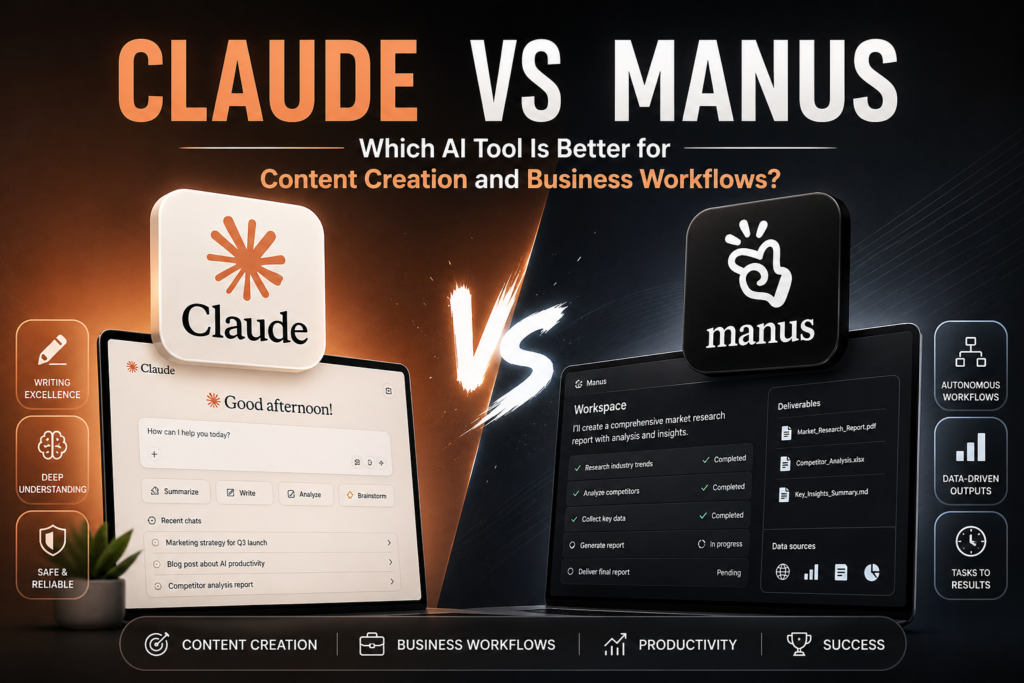
This is the most important distinction. Claude focuses on producing high-quality output content that informs, persuades, and engages. Manus focuses on execution completing tasks, running workflows, and automating systems. If you measure success by how good something reads, Claude wins. If you measure success by how much work gets done automatically, Manus wins.
2. Thinking vs Doing
Claude is designed to think. It processes context, builds arguments, and explains ideas. Manus is designed to do. It follows instructions, executes steps, and completes workflows. This difference alone should guide your decision.
3. Best Fit by Role
Claude is ideal for:
- Content creators
- Marketers
- Students and researchers
- Founders building brand voice
Manus is ideal for:
- Operations teams
- Automation specialists
- Businesses scaling backend systems
- Teams managing repetitive workflows
4. Ease of Use and Learning Curve
Claude is simple. You give it a prompt, and it delivers structured output. Manus may require more setup, especially when integrating workflows or automations. For beginners or content-focused users, Claude is easier to adopt.
Which One Should You Choose?
The answer depends entirely on your goal.
Choose Claude If:
- You need blogs, captions, emails, or reports
- You care about tone, clarity, and engagement
- You want content that feels human
- You are building a personal or business brand
Choose Manus If:
- You want to automate tasks
- You need workflows to run without manual input
- You are optimizing operations
- You want systems that execute actions
The Smart Approach: Use Both Strategically
This is where most people think too narrowly. Claude and Manus are not direct competitors they are complementary tools. You can use Claude to create high-quality content, strategies, and messaging. Then use Manus to distribute, automate, and execute those strategies at scale. That combination is far more powerful than choosing one over the other.
Real-World Example
Imagine you run a digital agency.
You use Claude to:
- Write SEO blogs
- Create social media content
- Build marketing strategies
Then you use Manus to:
- Schedule posts
- Automate lead follow-ups
- Manage workflows
One tool creates value.
The other scales it.
Conclusion
When comparing Claude vs Manus, the question isn’t “Which is better?” it’s “What are you trying to achieve?” Claude is your best choice for content, communication, and clarity. Manus is your best choice for execution, automation, and scaling systems. If you’re focused on growth, the real advantage comes from understanding how to use each tool in the right context. Choose based on your goal and when possible, combine both to build a smarter, more efficient workflow.