
Best Time to Post on LinkedIn in 2026: Best Days, Hours, and Strategies
Finding the best time to post on LinkedIn can make a meaningful difference in how many people discover and engage with your content. However, the ideal publishing time isn’t the same for everyone. A marketing consultant, software company, recruiter, and business owner may attract audiences with very different browsing habits.
Recent research also shows why you shouldn’t rely on outdated posting advice. Sprout Social’s March 2026 research highlights strong weekday engagement, particularly Tuesday through Thursday. Meanwhile, Buffer’s September 2026 analysis of more than 4.8 million LinkedIn posts found that late afternoons and evenings performed particularly well. These findings suggest that audience behavior can shift and that testing matters.
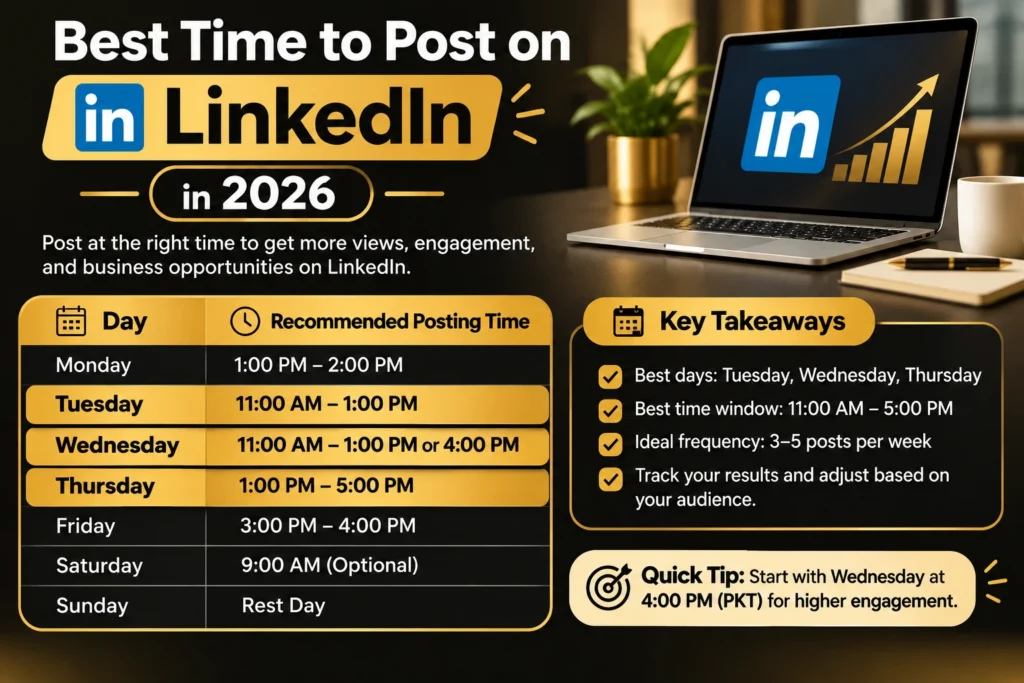
So, what is the best time to post on LinkedIn? If you need a practical starting point, test weekday afternoons, especially Wednesday around 4 p.m. Also compare midday publishing windows instead of assuming one schedule works for every audience.
In this guide, you’ll discover the best days and hours to publish, how posting times differ across industries and countries, and how to use LinkedIn Analytics to build a reliable schedule. You’ll also learn how often to publish and how to improve your content performance without overwhelming your audience.
Key Takeaways
- Wednesday at 4 p.m. was Buffer’s strongest overall LinkedIn posting slot in its September 2026 study.
- Tuesday through Thursday showed strong weekday engagement in Sprout Social’s March 2026 research.
- Late afternoon and evening publishing deserve attention, particularly between 3 p.m. and 8 p.m.
- Your target audience’s location and professional routine matter more than your own time zone.
- LinkedIn Analytics can help you compare impressions, engagement, and audience demographics.
- Consistent, useful content matters more than publishing at one supposedly perfect hour.
- Test different time slots before making long-term scheduling decisions.
What Is the Best Time to Post on LinkedIn?
The best time to post on LinkedIn depends on your audience, industry, and content strategy. However, recent 2026 research provides useful starting points.
Buffer analyzed more than 4.8 million LinkedIn posts and identified 3 p.m. to 8 p.m. on weekdays as a strong overall engagement window. Its leading individual time slot was Wednesday at 4 p.m. Sprout Social’s research, based on nearly two billion engagements across 307,000 social profiles, found stronger LinkedIn engagement during weekday business hours, particularly Tuesday through Thursday.
These studies don’t produce identical recommendations. They use different datasets and research periods. That’s precisely why you should treat industry-wide timing recommendations as testing opportunities rather than universal rules.
Best Time to Post on LinkedIn at a Glance
The following table combines the practical recommendations from both studies. Buffer’s individual time slots are especially useful for testing later publishing hours, while Sprout’s findings provide additional midday opportunities.
| Day | Times worth testing | Publishing priority |
| Monday | 1–2 p.m., 5 p.m., 9–10 p.m. | Moderate |
| Tuesday | 11 a.m.–5 p.m., 4–5 p.m. | High |
| Wednesday | 11 a.m.–4 p.m., especially 3–5 p.m. | High |
| Thursday | 11 a.m., 1–5 p.m., 5–7 p.m. | High |
| Friday | 1–4 p.m., especially 3–4 p.m. | High |
| Saturday | 9 a.m. or 6 p.m. | Experimental |
| Sunday | 6 a.m., 6 p.m., or 9–10 p.m. | Experimental |
All times refer to the target audience’s local time. These are research-informed testing windows, not guaranteed performance predictions.
What Day Gets the Most Engagement on LinkedIn?
Wednesday is a useful day to prioritize when testing LinkedIn engagement. Buffer’s September 2026 research identified Wednesday as its strongest overall day, with Wednesday at 4 p.m. leading its individual time slots.
However, Sprout Social’s March 2026 findings emphasize Tuesday, Wednesday, and Thursday as particularly consistent engagement days. The difference reflects separate datasets and methodologies.
For practical scheduling, prioritize Wednesday and Thursday for important content. Then test Tuesday and Friday to identify additional opportunities.
Best Days and Times to Post on LinkedIn
Each weekday offers different opportunities to reach professionals. Rather than copying a generic calendar, consider how your audience works and when it might have time to explore professional content.
Best Time to Post on LinkedIn on Monday
Monday gives professionals an opportunity to catch up after the weekend. However, many people begin their week with meetings, planning, and outstanding tasks.
Consider testing these windows:
- 1–2 p.m.
- 5 p.m.
- 9–10 p.m.
Sprout Social identifies 1–2 p.m. as a useful Monday window. Buffer’s 2026 data also highlights evening opportunities, including 5 p.m., 9 p.m., and 10 p.m.
Monday works well for content that helps professionals organize their week.
For example, a marketing consultant might share a weekly campaign planning checklist. A business coach could publish practical advice about setting priorities.
Content ideas for Monday:
- Weekly industry updates.
- Business planning tips.
- Professional development advice.
- Short educational posts.
- Weekly goals and lessons.
If your audience consists of senior executives, test early afternoon publishing before moving toward evening slots.
Best Time to Post on LinkedIn on Tuesday
Tuesday offers several opportunities to reach professionals during their working week.
Sprout Social’s March 2026 research identifies Tuesday from 11 a.m. to 5 p.m. as a strong window. Buffer also found useful engagement opportunities around 4 p.m., 5 p.m., and 10 p.m.
For B2B businesses, Tuesday can be useful for publishing detailed educational content.
Recommended content ideas:
- Industry research and observations.
- B2B marketing strategies.
- Product demonstrations.
- Business case studies.
- Professional problem-solving advice.
If you publish a detailed LinkedIn document or educational post, compare its performance at midday and late afternoon.
Best Time to Post on LinkedIn on Wednesday
Wednesday deserves particular attention in a weekly posting schedule.
Buffer identified Wednesday at 4 p.m. as its strongest overall posting slot in 2026. Its research also highlighted 3 p.m. and 5 p.m. as strong Wednesday opportunities.
Sprout Social found another useful window between 11 a.m. and 4 p.m.
Try these publishing times:
- 11 a.m.
- 1 p.m.
- 3 p.m.
- 4 p.m.
- 5 p.m.
Wednesday is suitable for content that demonstrates expertise and encourages professional discussion.
For example, a LinkedIn consultant could share a breakdown of common profile optimization mistakes. A software company might publish a short case study explaining how its product solves a specific business problem.
Rather than publishing several posts at once, spread your content across different Wednesdays and compare the results.
Best Time to Post on LinkedIn on Thursday
Thursday provides another opportunity to reach professionals before the weekend.
Sprout Social highlights 11 a.m. and 1–5 p.m. as useful Thursday windows. Buffer’s research identifies 5 p.m., 7 p.m., and 9 p.m. among its stronger Thursday slots.
Consider publishing:
- Business growth strategies.
- Industry trends.
- Customer success stories.
- Professional opinions.
- Company announcements.
Thursday can also work well for a thoughtful post that summarizes an industry development and invites readers to share their experiences.
Best Time to Post on LinkedIn on Friday
Friday often brings a different professional mindset. Some people finish important tasks, while others prepare for the following week.
Buffer’s research identifies 3 p.m., 4 p.m., and 5 p.m. as promising Friday publishing times. Sprout Social also highlights 11 a.m. and 1–2 p.m.
Useful Friday content includes:
- Weekly business lessons.
- Project highlights.
- Team achievements.
- Short industry summaries.
- Professional reflections.
For example, a business owner could share three lessons learned from a recent client project. This gives readers something practical without requiring a lengthy technical discussion.
Best Time to Post on LinkedIn on Saturday
Saturday generally receives less consistent professional engagement than weekdays. However, that doesn’t mean weekend publishing never works.
Buffer’s 2026 analysis identified Saturday at 9 a.m. as one of its more promising individual slots.
Saturday publishing may suit:
- Career advice.
- Personal branding content.
- Professional reflections.
- Educational resources.
- Content targeting entrepreneurs and independent professionals.
If your followers regularly use LinkedIn outside traditional working hours, Saturday may deserve a place in your experiment.
Don’t assume weekend activity matches weekday performance. Compare the results before committing to a recurring schedule.
Best Time to Post on LinkedIn on Sunday
Sunday can offer opportunities to connect with professionals preparing for a new week.
Buffer identified Sunday evening activity, including around 9–10 p.m., alongside an early-morning opportunity.
Potential Sunday content includes:
- Weekly planning advice.
- Career development tips.
- Leadership lessons.
- Professional reflections.
- Industry reading recommendations.
For most business accounts, weekday publishing should remain the initial priority. Use Sunday only when your own analytics support it.
Best Time to Post on LinkedIn by Industry
Your industry influences who follows your account and when those people use LinkedIn.
A recruiter may reach candidates during different hours than a financial consultant. Likewise, a software company targeting chief technology officers may need a different schedule from a university recruiting graduates.
The following recommendations provide testing directions rather than verified industry-specific peak-hour statistics.
Best Time to Post on LinkedIn for Marketing and Advertising
Marketing professionals often follow campaign developments, industry discussions, and practical growth advice.
Test Tuesday through Thursday, particularly midday and late afternoon.
Content that fits this audience:
- Search engine optimization insights.
- Social media marketing strategies.
- Advertising campaign breakdowns.
- Content marketing advice.
- Lead generation techniques.
A marketing agency can also compare educational posts with client success stories to discover which topics generate meaningful conversations.
Best Time to Post on LinkedIn for Technology and Software
Technology audiences include developers, engineers, founders, product managers, and IT decision-makers.
Their professional routines can differ significantly.
Test weekday afternoons and compare the results with traditional midday slots.
Useful content formats include:
- Software tutorials.
- Product updates.
- Technical explanations.
- Cybersecurity insights.
- Industry research.
- Customer implementation stories.
For enterprise software companies, focus on the time zones and working schedules of actual decision-makers rather than assuming every technology professional follows the same routine.
Best Time to Post on LinkedIn for Financial Services
Financial services professionals often follow economic developments, business news, investment research, and regulatory updates.
Test weekday publishing during the audience’s normal professional hours. Also consider whether your content relates to time-sensitive market developments.
Useful subjects include:
- Financial education.
- Business finance.
- Risk management.
- Industry developments.
- Financial planning insights.
Always distinguish educational commentary from personalized financial advice.
Best Time to Post on LinkedIn for Education and Training
Universities, training providers, and education professionals use LinkedIn to share opportunities, research, and career information.
Consider testing weekday midday and afternoon windows.
Relevant content includes:
- Professional development programs.
- Educational research.
- Career guidance.
- Training opportunities.
- Graduate success stories.
If students and working professionals form separate audience groups, compare their engagement patterns rather than treating them as one audience.
Best Time to Post on LinkedIn for Healthcare
Healthcare audiences include physicians, administrators, researchers, educators, and healthcare technology professionals.
Their schedules can vary substantially. Some work conventional office hours, while others follow shifts or clinical schedules.
Test different weekday windows and examine which professional roles engage with your posts.
Useful topics include:
- Healthcare technology.
- Professional education.
- Research developments.
- Healthcare management.
- Patient experience improvements.
Avoid assuming that every healthcare professional checks LinkedIn during standard office hours.
Best Time to Post on LinkedIn for Recruitment and HR
Recruiters, hiring managers, and job seekers have different reasons for using LinkedIn.
Recruiters may look for candidates during working hours. Job seekers may explore career opportunities outside their normal workday.
Test weekday morning, afternoon, and early-evening publishing.
Useful posts include:
- Job opportunities.
- Interview preparation.
- Hiring insights.
- Workplace culture.
- Recruitment trends.
- Career development advice.
Track qualified applications and relevant conversations rather than measuring success through likes alone.
Best Time to Post on LinkedIn for Consulting and Professional Services
Consultants often target business owners, executives, and department leaders.
These audiences may value specific insights that help them make decisions.
Test Tuesday through Thursday and compare midday with late-afternoon publishing.
Useful content includes:
- Client case studies.
- Business growth frameworks.
- Leadership advice.
- Operational improvements.
- Industry analysis.
- Problem-solving guides.
A detailed post explaining how a company addressed a real business challenge can attract more relevant attention than a generic promotional message.
Best Time to Post on LinkedIn for Nonprofit Organizations
Nonprofits may target donors, volunteers, corporate partners, and community professionals.
Their audience behavior can differ from commercial B2B accounts.
Test weekday publishing first. Then compare weekend opportunities when promoting community activities or volunteer events.
Useful content includes:
- Fundraising campaigns.
- Community achievements.
- Volunteer opportunities.
- Impact reports.
- Partnership announcements.
Measure meaningful actions, such as event registrations, volunteer inquiries, and donations, where applicable.
Best Time to Post on LinkedIn by Country and Time Zone
Location matters because LinkedIn connects professionals across different countries.
If your company operates in Pakistan but targets business owners in the United States, publishing according to Pakistan’s working hours may not reach your intended audience at the right moment.
The important question isn’t when you’re online. It’s when your target audience is likely to be available.
Best Time to Post on LinkedIn in the United States
The United States covers several time zones, including Eastern, Central, Mountain, and Pacific.
A single publishing time won’t suit every region.
If most of your followers work on the East Coast, test schedules using Eastern Time. If your audience is concentrated in California, compare Pacific Time instead.
For a nationwide B2B audience, test more than one publishing window to understand regional differences.
Best Time to Post on LinkedIn in the United Kingdom
For UK-focused businesses, use UK local time when planning your content calendar.
Test weekday midday and late-afternoon windows. Consider the effect of British Summer Time when comparing results across different months.
If your audience includes professionals in both the UK and continental Europe, account for their local working schedules.
Best Time to Post on LinkedIn in Pakistan
Businesses targeting Pakistani professionals should start by testing weekday publishing in Pakistan Standard Time (PKT).
Useful starting windows include:
- 11 a.m.–1 p.m.
- 3–5 p.m.
- 5–7 p.m.
These are experimental windows based on the broader 2026 research patterns, not independently verified Pakistan-specific peak hours.
For businesses targeting local decision-makers, consider the working schedules of your particular sector. A software company, recruitment agency, and educational institution may attract different audiences.
Best Time to Post on LinkedIn in Canada
Canada spans multiple time zones. Toronto, Vancouver, Calgary, and Montreal do not share identical local times.
Identify the locations that contribute most to your followers.
Then test publishing according to those regional time zones rather than relying on one national schedule.
Best Time to Post on LinkedIn in Australia
Australia also covers multiple time zones, with seasonal clock changes in some regions.
Businesses targeting Sydney and Melbourne should consider Eastern Australian time. Companies reaching Perth should test Western Australian time separately.
Review your audience demographics before choosing a schedule.
How to Schedule LinkedIn Posts for International Audiences
Use this simple process:
- Open your LinkedIn audience analytics.
- Identify your leading follower locations.
- Select the countries most relevant to your business.
- Convert your publishing schedule into those local time zones.
- Test different windows for each audience group.
- Compare results and adjust your calendar.
For example, a Pakistan-based agency targeting US clients might schedule separate posts for Pakistani and American professional audiences.
One global schedule isn’t always the most practical approach.
Does Your LinkedIn Content Type Affect the Best Posting Time?
Yes, content format can influence how people interact with your posts.
A short text update takes seconds to read. A detailed document may require several minutes. A video may appeal to people who prefer watching rather than reading.
However, there isn’t enough universal evidence to assign one guaranteed peak hour to every LinkedIn format.
Instead, compare similar content types across different publishing windows.
Best Time to Post LinkedIn Text Updates
Text updates work well when you have a clear observation, useful lesson, or professional question.
Try publishing during your tested weekday windows.
Keep the opening lines specific and relevant. Give readers a reason to continue.
For example:
“Many B2B companies publish regularly but still struggle to generate qualified leads. The problem often starts with unclear audience targeting.”
This opening introduces a recognizable business problem and creates a reason to read further.
Best Time to Publish LinkedIn Articles
LinkedIn articles provide room for detailed explanations and professional insights.
They suit subjects such as:
- Industry research.
- Technical guides.
- Leadership analysis.
- Business strategy.
- Professional education.
Consider promoting a new article through a separate LinkedIn post. The promotional update should explain what readers will learn rather than simply announcing a new publication.
Best Time to Share LinkedIn Document and Carousel Posts
Document posts can help explain complex ideas through organized slides or pages.
Examples include:
- SEO checklists.
- Marketing frameworks.
- Business process guides.
- Industry statistics.
- Professional training materials.
Test these posts during your strongest weekday windows.
Make the first page clear enough to communicate the subject immediately. Keep each following page focused on one main idea.
Best Time to Post LinkedIn Videos
Videos can demonstrate products, explain professional concepts, and introduce people behind a business.
Consider testing weekday afternoon and early-evening windows.
Pay attention to relevant video analytics, including views and viewing time. A large impression count doesn’t necessarily mean viewers watched the entire video.
Start with a clear explanation of the problem or topic. Avoid lengthy introductions.
Best Time to Publish LinkedIn Polls
Polls can encourage participation when they ask a relevant professional question.
For example, a marketing agency might ask:
“Which LinkedIn activity takes the most time for your business?”
- Content creation.
- Finding potential clients.
- Profile optimization.
- Performance analysis.
Choose questions that reveal something useful about your audience. Avoid polls that generate votes without offering meaningful insight.
Best Time to Post on LinkedIn for Personal Profiles vs. Company Pages
Personal profiles and company pages can serve different purposes. Their audiences and content expectations may also differ.
Best Posting Times for Personal LinkedIn Profiles
Personal profiles often support professional networking, thought leadership, and personal branding.
An individual consultant might share:
- Lessons from client projects.
- Professional experiences.
- Industry observations.
- Career advice.
- Practical business strategies.
Test weekday afternoons and compare them with the morning and midday windows.
A useful personal-branding post should demonstrate a clear point of view or practical experience.
Best Posting Times for LinkedIn Company Pages
Company pages help organizations communicate with customers, employees, partners, and prospective clients.
Their content might include:
- Product announcements.
- Company news.
- Hiring updates.
- Industry reports.
- Customer stories.
- Business resources.
LinkedIn Page analytics can help administrators compare content performance and audience demographics.
Don’t automatically copy an employee’s personal posting schedule onto a company page. Test each account independently.
How B2B and B2C Audiences Differ on LinkedIn
B2B marketing typically focuses on business needs, professional responsibilities, and organizational decisions.
B2C content may focus more on individual consumer interests and purchasing considerations.
| Factor | B2B audience | B2C audience |
| Typical interests | Business solutions and industry knowledge | Products and consumer experiences |
| Content examples | Case studies and industry analysis | Product education and customer stories |
| Decision process | Often involves multiple stakeholders | Often involves individual or household decisions |
| Useful performance signals | Qualified inquiries and professional conversations | Relevant clicks and conversions |
These are broad distinctions, not fixed rules. A B2C brand selling professional products may attract a strongly business-oriented LinkedIn audience.
How to Find Your Own Best Time to Post on LinkedIn
General research provides a starting point. Your own analytics should determine your long-term schedule.
Follow this practical process to identify the publishing windows that suit your audience.
Step 1: Understand Your LinkedIn Audience
Before selecting a posting time, identify the people you want to reach.
Review relevant audience information, including:
- Location.
- Industry.
- Job title.
- Seniority.
- Company size.
- Professional interests.
LinkedIn provides audience information through available creator and Page analytics.
For example, a company targeting marketing directors in the United States should prioritize their local time zones rather than the publishing team’s location.
Step 2: Review LinkedIn Analytics
LinkedIn offers post-level analytics that help members understand how their content performs.
For personal profiles, you can review individual post analytics to examine impressions, members reached, engagement, and available viewer demographics.
For company pages, administrators can access content analytics and compare individual posts.
Useful metrics include:
| Metric | What it tells you |
| Impressions | How many times your post appeared |
| Members reached | How many distinct members and Pages saw it |
| Reactions | How many people reacted to the post |
| Comments | How many comments the post received |
| Reposts | How many times people shared it |
| Clicks | How many people clicked relevant content |
| Engagement rate | How interactions compare with impressions |
Remember that impressions and members reached measure different things. One person can generate multiple impressions.
LinkedIn also notes that some analytics figures are estimates.
Step 3: Test Different Posting Times
Choose several time windows and compare their results.
For example, create a four-week experiment:
| Week | Test schedule |
| Week 1 | Tuesday at 12 p.m. and Wednesday at 4 p.m. |
| Week 2 | Thursday at 1 p.m. and Friday at 4 p.m. |
| Week 3 | Tuesday at 5 p.m. and Wednesday at 3 p.m. |
| Week 4 | Thursday at 5 p.m. and Friday at 3 p.m. |
Publish comparable content across the test period.
Avoid comparing a detailed case study with a simple announcement and attributing the entire difference to posting time.
Try to keep these factors reasonably consistent:
- Content format.
- Topic relevance.
- Audience.
- Writing quality.
- Call to action.
- Measurement period.
Step 4: Measure Engagement and Reach
After publishing, review your analytics at consistent intervals.
Compare the results rather than judging a post from its first few minutes.
Useful questions include:
- Which time generated more impressions?
- Which post reached more relevant professionals?
- Which time attracted more meaningful comments?
- Which publishing window generated more profile visits?
- Which posts attracted relevant website clicks?
For B2B marketing, a smaller number of meaningful conversations may be more valuable than hundreds of unrelated reactions.
Step 5: Build a Consistent LinkedIn Posting Schedule
Once you identify promising publishing windows, create a weekly content calendar.
For example:
| Day | Content idea | Testing time |
| Tuesday | Educational industry insight | 4 p.m. |
| Wednesday | Case study or practical guide | 4 p.m. |
| Thursday | Thought leadership | 5 p.m. |
| Friday | Weekly business lesson | 3 p.m. |
This schedule provides a starting framework. Adjust it according to actual performance.
Review your results regularly and repeat the experiment when your audience, industry, or publishing goals change.
How Often Should You Post on LinkedIn?
Posting frequency matters because it influences how consistently your audience encounters your content.
However, publishing more often doesn’t automatically improve performance.
A business that publishes three useful posts each week may create more value than one that publishes seven repetitive updates.
Start with a schedule you can maintain without sacrificing quality.
For many individuals and small businesses, three to five useful posts per week can serve as a practical testing range. This is a planning recommendation, not a universal LinkedIn requirement or guaranteed engagement benchmark.
Is Posting on LinkedIn Every Day a Good Idea?
Daily publishing can work when you have enough relevant ideas and resources to maintain quality.
However, it can become difficult to sustain.
Before choosing daily publishing, consider:
- Can you produce genuinely useful content?
- Do you have enough relevant industry topics?
- Can you respond to audience conversations?
- Does daily publishing support your business goals?
If the answer is no, reduce the frequency.
How Many LinkedIn Posts Should You Publish Per Week?
A manageable starting schedule might look like this:
| Publishing frequency | Suitable approach |
| 1–2 posts weekly | New accounts or limited resources |
| 3 posts weekly | Consistent educational content |
| 4–5 posts weekly | Active personal brands and business pages |
| Daily publishing | Accounts with a sustainable content operation |
Choose the schedule that supports your objectives.
How Much Time Should You Leave Between LinkedIn Posts?
Avoid publishing multiple updates close together simply to increase activity.
Give each post a reasonable opportunity to attract attention and generate discussion.
For a business publishing three or four times weekly, spacing posts across different days often makes planning easier.
Focus on the value of each publication rather than trying to fill every available time slot.
Common LinkedIn Posting Time Mistakes to Avoid
Even a well-planned schedule can fail when you ignore audience behavior or content quality.
Avoid these common mistakes.
Following Generic Posting Schedules Without Checking Analytics
Industry studies combine results from many accounts.
Your audience may behave differently.
Use published research to select test windows, then evaluate your own results.
Ignoring Your Audience’s Time Zone
Publishing at 9 a.m. in Pakistan may not suit an audience based in California.
Always schedule around the people you want to reach.
Publishing Too Frequently Without Valuable Content
More posts don’t automatically mean more meaningful engagement.
If your updates repeat the same ideas, people have fewer reasons to interact.
Publish when you have something useful to share.
Choosing Posting Times Based Only on Likes
Likes offer only one view of content performance.
A post that generates fewer reactions might still attract relevant profile visits, website clicks, and business inquiries.
Measure results against your actual goals.
Ignoring Comments and Audience Conversations
LinkedIn is a professional networking platform, not simply a publishing channel.
Respond thoughtfully to comments and participate in relevant discussions.
Meaningful conversations help you build professional relationships beyond individual posts.
Changing Your Posting Schedule Too Frequently
One successful post doesn’t establish a reliable pattern.
Likewise, one disappointing post doesn’t prove that a time slot is ineffective.
Collect enough comparable observations before changing your schedule.
Best Practices for Getting More Engagement on LinkedIn
Publishing at a suitable time helps your content meet its audience. However, the content itself must give people a reason to stop scrolling.
Use these practices to strengthen your LinkedIn content posting strategy.

Write Strong Opening Lines That Capture Attention
Your opening lines should introduce a specific problem, observation, or useful idea.
Instead of writing:
“Today, we will discuss LinkedIn marketing.”
Try:
“Your LinkedIn profile may attract visitors but still fail to generate business inquiries.”
The second example introduces a recognizable problem and gives readers a reason to continue.
Share Relevant Industry Knowledge and Practical Advice
Useful posts demonstrate that you understand your audience’s challenges.
For example, an SEO agency might explain how to identify indexing problems in Google Search Console.
A LinkedIn consultant could share a practical headline optimization framework.
Avoid broad advice that readers can find everywhere. Give them a specific action they can apply.
Use Relevant Hashtags Naturally
Hashtags can help describe the subject of a post.
Use a small number of relevant hashtags when they genuinely support discoverability.
Examples include:
- #LinkedInMarketing
- #B2BMarketing
- #PersonalBranding
- #LeadGeneration
- #ContentMarketing
Don’t add unrelated hashtags simply to make a post look more optimized.
Encourage Meaningful Conversations
Ask questions that invite professional opinions or practical experiences.
For example:
“Which LinkedIn content format has generated the most qualified conversations for your business?”
This question encourages responses that can provide useful insight.
Avoid engagement bait that asks for meaningless reactions.
Respond to Comments and Build Professional Relationships
When someone leaves a thoughtful comment, respond with relevant information.
You can also ask a follow-up question or share a useful resource.
The goal is to develop a conversation rather than simply acknowledge every comment with a generic response.
Review Performance and Refine Your Content Strategy
Set aside time each month to review your LinkedIn analytics.
Identify:
- Your strongest publishing days.
- Your most effective time windows.
- Topics that attract relevant audiences.
- Formats that generate useful engagement.
- Posts that contribute to business goals.
Use these observations to improve your next content calendar.
Final Thoughts
Finding the best time to post on LinkedIn requires more than following a popular posting schedule.
Recent 2026 research offers useful starting points. Buffer highlights Wednesday at 4 p.m. and late-afternoon publishing, while Sprout Social identifies strong weekday engagement from Tuesday through Thursday.
However, your audience may follow different professional routines.
Start by testing several publishing windows. Review impressions, engagement, audience demographics, and meaningful business outcomes. Then use those findings to build a consistent LinkedIn posting schedule.
Most importantly, don’t let timing distract you from content quality. A relevant post that solves a real problem can create more value than a perfectly timed update with nothing useful to say.
Frequently Asked Questions
What Is the Best Time to Post on LinkedIn in 2026?
Buffer’s September 2026 study identified 3–8 p.m. on weekdays as a strong overall engagement window, with Wednesday at 4 p.m. as its strongest individual slot.
Sprout Social’s March 2026 study identified strong weekday engagement, especially Tuesday through Thursday during business hours.
Test both midday and late-afternoon windows to determine which suits your audience.
What Is the Best Day to Post on LinkedIn?
Wednesday is a useful starting point. Buffer’s 2026 analysis identified it as the strongest overall day.
However, Sprout Social also found strong engagement across Tuesday, Wednesday, and Thursday.
Compare these days using your own account analytics.
Is Monday or Friday Better for LinkedIn Posts?
There isn’t one universal answer.
Monday can work for weekly planning and professional advice. Friday can suit business lessons, project updates, and weekly reflections.
Test both days and compare relevant engagement rather than relying on assumptions.
Is It Better to Post on LinkedIn in the Morning or Afternoon?
Recent research provides support for both windows.
Sprout Social identified strong midday and afternoon activity. Buffer’s September 2026 research found particularly strong late-afternoon and evening engagement.
For a useful experiment, compare a midday post with one published around 4 p.m.
Are Weekends Good for Posting on LinkedIn?
Weekends generally show less consistent professional engagement than weekdays.
However, Buffer’s research identified some promising Saturday and Sunday time slots.
Weekend publishing may suit entrepreneurs, independent professionals, and audiences that use LinkedIn outside traditional working hours.
Check your own results before removing weekends from your calendar.
What Is the Worst Time to Post on LinkedIn?
No single hour is universally the worst for every LinkedIn audience.
However, periods when your target audience is unlikely to be active may produce weaker results.
Use your analytics to identify consistently underperforming time windows instead of relying on a universal worst-time claim.
Does Posting Time Affect LinkedIn Reach?
Posting time can influence whether your target audience has an opportunity to see and interact with your content.
However, reach also depends on audience relevance, content quality, and other platform distribution factors.
A suitable publishing time cannot guarantee a particular number of impressions.
How Many Times a Week Should I Post on LinkedIn?
Three to five useful posts per week can provide a manageable starting schedule for many active professionals and businesses.
However, your ideal frequency depends on your resources and audience response.
Prioritize consistent, relevant publishing over unnecessary volume.
Can I Schedule LinkedIn Posts in Advance?
Yes. LinkedIn supports native post scheduling for eligible accounts and content.
You can also use third-party social media management tools to organize and schedule content.
Check the available scheduling options in your account before selecting a tool.
How Do I Check When My LinkedIn Followers Are Most Active?
Review your LinkedIn manage creator or Page analytics.
Look at audience demographics and post-level performance to understand who sees your content and how different publications perform.
LinkedIn provides useful information such as impressions, members reached, engagement, and available audience demographics. However, don’t assume it provides a universal hourly active-follower chart for every account.
Does LinkedIn Posting Time Matter for Company Pages?
Yes, publishing time can influence when a company page’s audience encounters its updates.
However, company pages should evaluate their own content analytics rather than copy the schedule of an individual’s personal profile.
Consider follower locations, industries, job roles, and the purpose of each publication.