
Personal Branding in 2026: The Exact Step-by-Step Guide to Build Your Brand From Zero
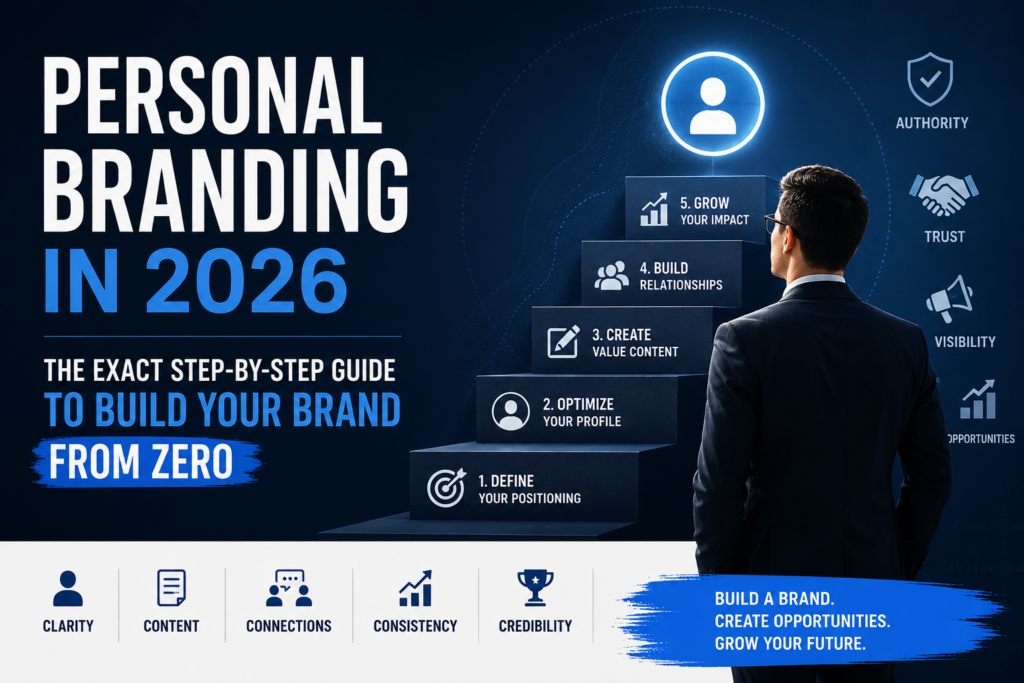
Most people think personal branding starts with posting content.
It doesn’t.
The reason most people fail at personal branding is because they start creating before they know what they want to be known for.
In 2026, building a personal brand is no longer optional. Whether you’re a business owner, freelancer, consultant, job seeker, or corporate professional, people are researching you before they decide to work with you.
The good news?
You don’t need thousands of followers, expensive equipment, or years of experience to get started.
You simply need a clear strategy.
This guide walks you through the exact steps to build personal branding from zero in 2026.
What Is Personal Branding?
Personal branding is the process of intentionally shaping how people perceive your expertise, credibility, and value online.
It’s not about becoming an influencer.
It’s about becoming known for something specific.
When done correctly, personal branding helps you:
- Attract opportunities
- Build trust faster
- Generate inbound leads
- Establish authority in your industry
- Differentiate yourself from competitors
Think of your personal brand as your professional reputation at scale.
Why Personal Branding Matters More Than Ever in 2026
People trust people before they trust companies.
AI-generated content is everywhere.
Ads are becoming easier to ignore.
Generic marketing messages are losing effectiveness.
As a result, audiences are placing more value on authentic expertise and real human insights.
When someone discovers your business, one of the first things they do is search your name.
If they find valuable content, industry insights, and a professional online presence, trust increases immediately.
If they find nothing, opportunities disappear before conversations even begin.
Step 1: Decide What You Want to Be Known For
Before creating content, define your positioning.
This is the foundation of your personal brand.
Ask yourself:
- What industry am I in?
- What problems do I solve?
- Who do I help?
- What expertise do I want to become known for?
Bad positioning:
“I help businesses grow.”
Strong positioning:
“I help B2B companies generate leads through LinkedIn marketing.”
Specific positioning attracts the right audience.
Broad positioning attracts nobody.
Action Step
Write this sentence:
“I help ______ achieve ______ through ______.”
Example:
“I help startup founders attract clients through LinkedIn personal branding.”
Step 2: Optimize Your LinkedIn Profile
Your LinkedIn profile is your digital storefront.
Many people will visit your profile before contacting you.
Make sure it communicates value immediately.
Update Your Headline
Instead of:
Marketing Manager at ABC Company
Use:
Helping SaaS Companies Generate Qualified Leads Through LinkedIn
Improve Your About Section
Include:
- Who you help
- Problems you solve
- Your expertise
- Results you’ve achieved
- A call to action
Use a Professional Banner
Your banner should reinforce your positioning.
Include:
- Your niche
- Key service
- Brand message
Action Step
Spend one hour optimizing your profile before creating your first piece of content.
Step 3: Identify 3 Core Content Pillars
Content becomes easier when you know what topics you’ll discuss consistently.
Choose three areas where you have experience, insights, or strong interest.
For example:
LinkedIn Consultant
Content Pillar 1:
LinkedIn Strategy
Content Pillar 2:
Lead Generation
Content Pillar 3:
Personal Branding
Business Owner
Content Pillar 1:
Industry Insights
Content Pillar 2:
Business Lessons
Content Pillar 3:
Client Success Stories
Action Step
Write down three content pillars today.
Every future post should fit into one of them.
Step 4: Start Creating Content Before You Feel Ready
The biggest mistake is waiting for perfection.
Your first content will not be amazing.
That’s normal.
The goal is consistency, not perfection.
Start with:
- Lessons learned
- Mistakes you’ve made
- Industry observations
- Client experiences
- Frameworks you use
- Frequently asked questions
The easiest formula:
Problem → Insight → Solution
Example:
“Many professionals struggle to grow on LinkedIn because they focus on posting instead of positioning. Before creating content, define what you want to be known for.”
Simple.
Valuable.
Easy to create.
Step 5: Commit to a Consistent Publishing Schedule
Personal brands are built through repetition.
Posting once a month will not produce meaningful results.
Consistency creates familiarity.
Familiarity creates trust.
Trust creates opportunities.
A practical schedule:
- 3–5 LinkedIn posts per week
- 1 long-form article per month
- Daily engagement with others
You don’t need to post every day.
You need to show up consistently.
Step 6: Become Visible in Other People’s Content
Creating content is only half the equation.
Distribution matters.
One of the fastest ways to grow is by engaging with industry leaders and potential clients.
Leave thoughtful comments.
Share insights.
Contribute to conversations.
Avoid generic comments such as:
“Great post.”
Instead say:
“We’ve seen the same trend with our clients. The biggest challenge isn’t content creation it’s maintaining consistency after the initial excitement fades.”
This demonstrates expertise.
Step 7: Document, Don’t Just Teach
People connect with journeys more than polished expertise.
You don’t need to be the world’s leading expert.
You simply need to share what you’re learning and experiencing.
Examples:
- A lesson from a client meeting
- A business challenge you solved
- A marketing experiment
- A recent success
- A mistake that taught you something valuable
This makes your content authentic and relatable.
Step 8: Build Authority Through Proof
Claims create interest. Proof creates trust.
Show evidence whenever possible.
Examples include:
- Case studies
- Client testimonials
- Before-and-after results
- Screenshots
- Certifications
- Project outcomes
Anyone can claim expertise.
Few can demonstrate it.
That’s where authority is built.
Step 9: Build Relationships, Not Just Followers
A strong personal brand is a network, not an audience.
Many people focus exclusively on follower counts.
What matters more is relationships.
Reach out to:
- Industry peers
- Potential partners
- Clients
- Podcast hosts
- Event organizers
Opportunities often come from conversations rather than content itself.
Step 10: Track What Works and Double Down
The best personal brands evolve through data.
Review your content every month.
Ask:
- Which posts generated engagement?
- Which topics attracted clients?
- Which formats performed best?
Double down on what resonates.
Stop overcomplicating what already works.
Common Personal Branding Mistakes to Avoid
Trying to Appeal to Everyone
Specificity wins.
Copying Influencers
Develop your own voice.
Posting Without Strategy
Content should support positioning.
Inconsistent Publishing
Trust is built through consistency.
Focusing Only on Followers
Relationships and opportunities matter more.
Personal Branding Roadmap: First 90 Days
| Timeline | Focus |
| Days 1-30 | Positioning and profile optimization |
| Days 31-60 | Consistent content creation |
| Days 61-90 | Engagement and relationship building |
If you follow this roadmap, you’ll already be ahead of most professionals trying to build a personal brand.
Frequently Asked Questions
How long does personal branding take?
Most people begin seeing noticeable results within three to six months of consistent content creation and engagement. Strong authority typically takes longer, but momentum starts much sooner.
Which platform is best for personal branding in 2026?
LinkedIn remains one of the most effective platforms for professionals, consultants, business owners, and B2B service providers because decision-makers actively use it.
Do I need thousands of followers?
No. A few hundred relevant followers can create more opportunities than tens of thousands of irrelevant followers.
What should I post if I’m a beginner?
Share lessons learned, industry insights, experiences, challenges, and observations. You don’t need to be an expert to provide value.
Can personal branding generate clients?
Yes. A strong personal brand builds trust before sales conversations happen, making it easier to attract qualified opportunities and inbound inquiries.
Conclusion
Building a personal brand in 2026 is not about becoming famous.
It’s about becoming known.
The professionals winning today are not necessarily the most talented. They’re often the most visible.
Start by defining your positioning.
Optimize your LinkedIn profile.
Create content consistently.
Engage with your industry.
Build relationships.
Do that for the next 90 days, and you’ll be surprised how quickly opportunities begin to appear.
The best time to start building your personal brand was years ago.
The second-best time is today.