
Branding vs Marketing vs Advertising: A Clear, In-Depth Explanation
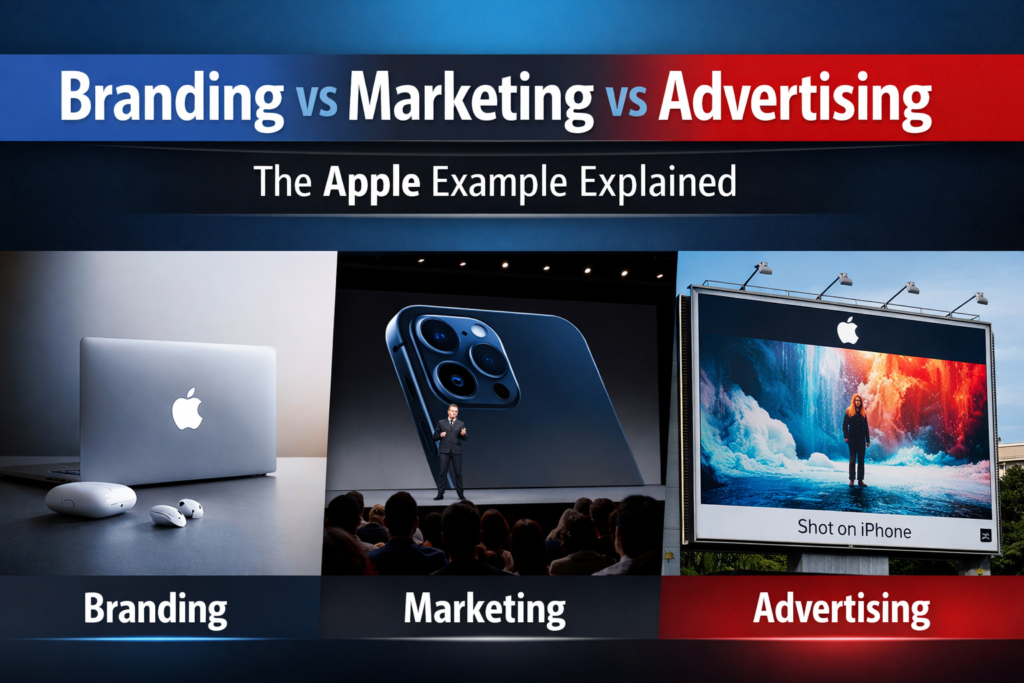
Branding, marketing, and advertising are often spoken about as if they are the same discipline. In practice, they serve very different purposes. When businesses fail to understand this distinction, they usually invest heavily in advertising while struggling to build recognition, trust, or loyalty. Growth becomes expensive, inconsistent, and short-lived.
To clearly explain the difference, this article explores branding, marketing, and advertising in depth and applies each one to the brand example: Apple.
Understanding the Relationship Between Branding, Marketing, and Advertising
The easiest way to understand these three concepts is to see them as layers. Branding sits at the core. Marketing is built on top of branding. Advertising is the outermost layer that brings visibility. Each layer depends on the one beneath it. When they are aligned, businesses grow with clarity and consistency. When they are misaligned, even large budgets fail to deliver long-term results.
Branding: The Strategic Foundation of the Business
Branding is not a logo, colour palette, or slogan. It is the sum of perceptions people hold about a company. It shapes how a brand is recognised, remembered, and trusted. Branding answers fundamental questions about identity, belief, and differentiation.
In Apple’s case, branding is rooted in simplicity, creativity, and human-centred design. From the earliest days, Apple positioned itself as the alternative to complex, intimidating technology. This positioning continues to influence everything from product design to retail experiences. Devices are visually minimal, packaging is uncluttered, and interfaces are designed to feel intuitive rather than technical.
Apple’s brand voice is calm, confident, and deliberate. It does not shout for attention or rely on exaggerated claims. Even silence and white space are part of its identity. Importantly, Apple does not frame itself as “the most powerful technology company” but as the company that makes advanced technology feel natural and accessible.
This is why Apple’s branding remains consistent across decades and product categories. Whether a customer interacts with an iPhone, a MacBook, or an Apple Store, the experience reinforces the same values. Branding sets expectations long before any marketing message is delivered.
Marketing: Translating Brand Identity into Market Relevance
Marketing takes the internal clarity created by branding and translates it into structured communication. It is the discipline that connects the brand to the market by defining who the audience is, what problems they face, and how the brand provides value.
Apple’s marketing approach is notable for what it chooses not to emphasise. Technical specifications are rarely the starting point. Instead, Apple markets outcomes, experiences, and emotional benefits. Product launch events are designed as narratives rather than technical briefings. Each feature is introduced through a problem it solves or an experience it enables.
On Apple’s website, product pages are carefully structured to guide the reader. The messaging focuses on what users can do with the product rather than what the product contains. Photography and video are used to show real-life usage scenarios, reinforcing relevance rather than abstraction.
This marketing strategy reflects a deep understanding of buyer psychology. Most customers do not buy technology because of processors or memory capacity. They buy because the product fits into their lifestyle, supports their creativity, or simplifies their work. Apple’s marketing aligns perfectly with its branding by making technology feel personal and meaningful.
Advertising: Amplifying a Focused Message at Scale
Advertising is the most visible aspect of the three, but it is also the most tactical. It involves paying for placement to amplify a specific message to a defined audience. Advertising works best when it reinforces an existing perception rather than trying to create one from scratch.
Apple’s advertising is highly disciplined. Campaigns are built around one clear idea rather than multiple competing messages. The “Shot on iPhone” campaign is a prime example. Instead of listing camera specifications, Apple simply showcases images taken by real users. The product becomes a creative tool rather than a technical device.
Apple’s television and digital ads are minimal in language and rich in visual storytelling. Many advertisements do not include prices, discounts, or aggressive calls to action. This restraint is deliberate. Apple’s advertising is designed to remind people of what they already associate with the brand: creativity, simplicity, and quality.
Because branding and marketing have already established trust and meaning, Apple’s advertising does not need to persuade aggressively. It reinforces identity and maintains presence.
Why Apple’s Approach Works So Effectively
Apple succeeds because it respects the hierarchy between branding, marketing, and advertising. Branding leads to every decision. Marketing translates that identity into relevant stories. Advertising amplifies only what is already clear and coherent.
Many brands reverse this process. They invest heavily in advertising without a strong brand foundation or clear marketing strategy. As a result, campaigns generate short-term attention but fail to build lasting value. Apple demonstrates that clarity compounds. Consistency reduces friction. Meaning lowers the cost of growth.
Final Perspective
Branding defines who you are and why you matter. Marketing explains that value in a way the market understands. Advertising scales the message through paid exposure. When these three disciplines work together, brands grow efficiently, build trust, and remain relevant over time.
Apple is not successful because it advertises more. It is successful because it understands the difference between branding, marketing, and advertising and uses each one with precision.