
Claude Design: The AI Tool That’s Redefining Visual Creation
What if you could turn a simple conversation into a fully functional prototype? What if creating pitch decks, wireframes, and marketing materials didn’t require years of design expertise? That future just arrived.
Anthropic launched Claude Design on April 17, 2026, introducing a new product that lets users collaborate with AI to create polished visual work including designs, prototypes, slides, and one-pagers. This isn’t just another AI image generator it’s a complete reimagining of how we move from ideas to execution.
For founders scrambling to create investor decks at midnight, product managers sketching wireframes in meetings, and marketers juggling visual campaigns without a design team, Claude Design represents a fundamental shift. And for professional designers? It’s opening doors to explore creative directions that were previously too time-intensive to consider.
Here’s everything you need to know about this groundbreaking tool and why it matters.
What Exactly Is Claude Design?
Claude Design is powered by Claude Opus 4.7, Anthropic’s most capable vision model, and it functions as a visual prototyping assistant rather than a simple image generator.
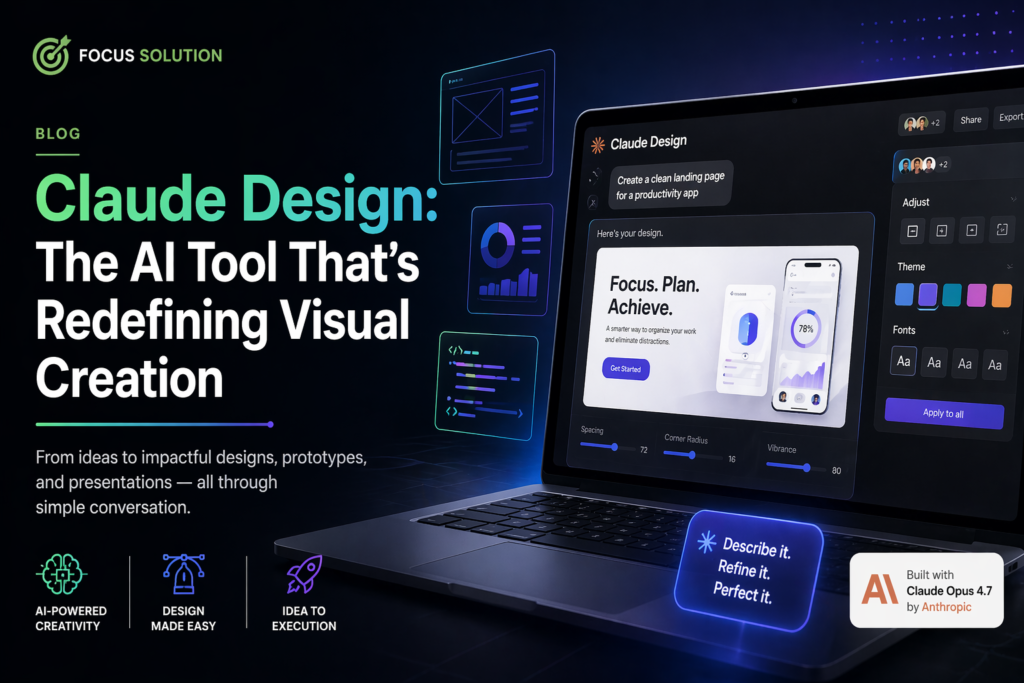
The workflow is conversational and intuitive. You describe what you need in plain language, and Claude builds an initial version. From there, you refine through natural conversation, inline comments, direct edits, or custom adjustment sliders that Claude itself generates.
Users can adjust spacing, color, and layout in real time using custom sliders generated by Claude, making the design process feel collaborative rather than transactional.
Think of it as having a design partner who never gets tired, works at the speed of thought, and can instantly apply feedback across your entire project.
Who Can Access Claude Design?
Claude Design is available in research preview for Claude Pro, Max, Team, and Enterprise subscribers, with gradual rollout throughout the day. You can access it at claude.ai/design.
For Enterprise organizations, there’s an important note: the product is turned off by default and must be enabled by an administrator in organization settings.
Usage is metered separately from other Claude services, with its own usage tracking, allowances, and weekly limits that sit alongside existing chat or Claude Code limits. This means your design work won’t eat into your regular Claude usage.
Enterprise customers on usage-based pricing get a bonus: a one-time credit covering about 20 typical prompts, which is consumed before additional usage counts toward organizational spend and expires on July 17.
The Power of Claude Opus 4.7
Understanding what makes Claude Design special requires understanding the engine behind it. Claude Opus 4.7 is Anthropic’s most capable vision model, able to see images in greater resolution and described as more tasteful and creative when doing professional tasks.
Opus 4.7 can create higher-quality interfaces, slides, and docs, which directly translates to better output from Claude Design. The model doesn’t just understand what you’re asking for it brings aesthetic judgment to the table.
This matters because design isn’t just about arranging elements correctly. It’s about making choices that feel intentional, polished, and appropriate for context. That’s where Opus 4.7’s enhanced capabilities shine.
Real-World Applications
Early users have discovered Claude Design excels at several specific use cases:
Realistic Prototypes and Wireframes Teams praised the tool’s ability to turn static designs into interactive prototypes, with complex pages that took 20-plus prompts in other tools requiring only 2 prompts in Claude Design. This acceleration is game-changing for product development cycles.
Pitch Decks That Actually Look Good Creating compelling investor presentations is notoriously time-consuming. Claude Design handles the visual heavy lifting, letting founders focus on their story and data rather than wrestling with slide layouts.
Marketing Materials Without a Design Team Small businesses and startups can now produce professional-looking social media posts, one-pagers, and promotional materials without hiring dedicated designers or learning complex software.
Design Exploration for Professionals Even experienced designers face constraints, rarely having time to prototype a dozen directions, forcing them to limit themselves to a few options. Claude Design removes that limitation, enabling rapid exploration of creative directions.
The Features That Make It Work
Claude Design includes several standout capabilities that separate it from basic AI design tools:
Collaborative Editing Designs support organization-scoped sharing where users can keep documents private, share for viewing with anyone in the organization who has the link, or grant edit access so colleagues can modify designs and chat with Claude together in group conversations.
This transforms design from a solitary activity into a team sport.
Flexible Export Options Users can share designs as internal URLs within their organization, save as folders, or export to Canva, PDF, PPTX, or standalone HTML files. This flexibility means Claude Design fits into existing workflows rather than forcing teams to change their processes.
Seamless Handoff to Claude Code Here’s where things get really interesting: When a design is ready to build, Claude packages everything into a handoff bundle that can be passed to Claude Code with a single instruction.
The handoff includes components, design tokens, copy, and interaction notes, creating a fluent, continuous pipeline from idea to shipped feature. This integration solves one of the longest-standing problems in product development—the gap between design and implementation.
Design System Integration Claude Design can apply a team’s design system to every project it creates by reading the company’s codebase and design files, ensuring results are consistent with overall visual style. Teams can also refine these components and maintain multiple design systems.
This capability is crucial for enterprises where brand consistency isn’t optional.
What This Means for Designers
The launch sparked immediate debate about AI’s impact on creative professions. Following the announcement, design company Figma’s stock fell about 7 percent, reflecting market concerns about disruption.
But the reality is more nuanced. Graphic designer Molly McCoy noted that people who don’t understand the different tiers of the design industry might struggle to grasp how tools like this impact it.
McCoy expects Claude Design will have significant impact on the corporate design world where there’s rigidity to the degree of creativity allowed, as it will efficiently produce work that follows established patterns.
However, Anthropic makes a moderate claim that Claude Design is intended to help people who need simple visual prototypes, one-pager templates, or presentations, not claiming to be a replacement for designers.
The most insightful perspective comes from practicing designers already using these tools: The designers who thrive won’t be those who adopt every tool fastest, but those who know when to let the pipeline accelerate and when to slow it down on purpose, recognizing when friction is the point.
The Canva Partnership
Rather than competing with Canva, Anthropic positions Claude Design as complementary, built for people who aren’t starting from a design tool and need to get from an idea to something visual quickly.
The collaboration makes it seamless for people to bring ideas and drafts from Claude Design into Canva, where they instantly become fully editable and collaborative designs ready to refine, share, and publish.
This partnership reflects a pragmatic understanding: not every tool needs to own the entire workflow. Sometimes the best strategy is creating excellent handoffs between specialized tools.
What’s Coming Next
Over the coming weeks, Anthropic plans to make it easier to build integrations with Claude Design so teams can connect it to more tools they already use.
The company is transparent about current limitations: The design system import works best with clean codebases, as messy source code produces messy output; collaboration is basic and not yet fully multiplayer; and the editing experience has rough edges.
There is no general availability date, and Anthropic says this is intentional, letting the product and user feedback determine when Claude Design is ready for prime time.
This measured approach launching in research preview and iterating based on real usage reflects lessons learned from previous AI product launches.
The Bigger Picture
Claude Design represents more than a new design tool. It’s the most visible expression of a trend where major AI labs are moving up the stack from model providers into full application builders, directly entering categories previously owned by established software companies.
The timing is significant. Anthropic hit roughly $20 billion in annualized revenue in early March 2026, up from $9 billion at the end of 2025, and surpassed $30 billion by early April 2026. The company is also in early talks with Goldman Sachs, JPMorgan, and Morgan Stanley about a potential IPO that could come as early as October 2026.
These numbers tell a story: AI companies that build complete product experiences—not just provide models—are capturing enormous value.
Should You Use Claude Design?
If you’re a founder, product manager, or marketer without design expertise, Claude Design is probably worth exploring immediately. The ability to rapidly create professional-looking prototypes and presentations can accelerate your work significantly.
For professional designers, the value proposition is different but equally compelling. The tool allows individuals without formal design training to bring ideas to life while supporting advanced workflows for professionals who can explore more ideas quickly and focus on refinement rather than repetitive tasks.
The key question isn’t whether AI will change design work—it already has. The question is how you’ll adapt to work alongside these tools rather than against them.
The Bottom Line
Claude Design isn’t perfect, and it won’t replace skilled designers working on complex, brand-defining projects. But it does solve real problems for real people.
It democratizes access to visual creation for non-designers while giving professionals more time to focus on high-value creative decisions. It bridges the gap between prototype and production through seamless integration with Claude Code. And it does all this through natural conversation rather than forcing users to master complex software.
As AI continues to reshape creative industries, tools like Claude Design highlight a growing trend toward conversational interfaces that simplify complex tasks.
The future of design isn’t human or AI it’s humans and AI working together, each doing what they do best. Claude Design is one of the clearest examples yet of what that collaboration looks like.
Ready to see what you can create? Head to claude.ai/design and start building.