
Is the Marketing Funnel Dead? Or Are Most Businesses Just Using It Wrong?
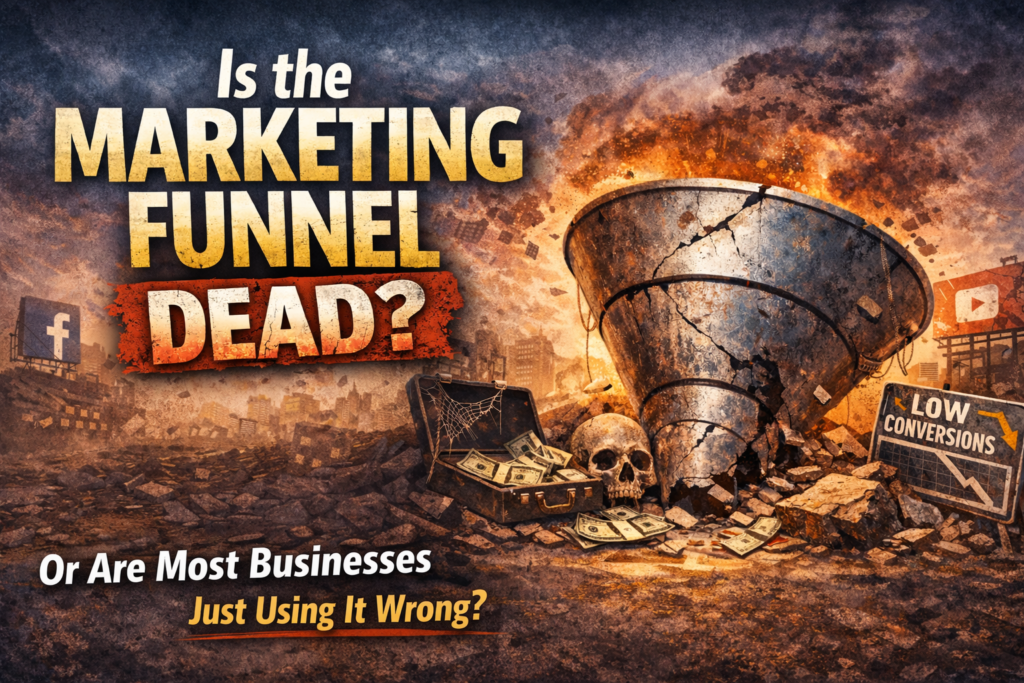
For years, the marketing funnel has been treated as the central operating system of modern digital marketing strategy. It promised structure in a chaotic market, predictability in customer acquisition, and clarity in conversion optimization. Founders were told that if they could simply move prospects from awareness to consideration to decision through a carefully engineered funnel, revenue would follow with mechanical reliability.
Yet today, across industries, a growing narrative suggests that the marketing funnel is obsolete. Rising ad costs, declining organic reach, fragmented customer journeys, and unpredictable buying behavior have caused many to question whether the traditional sales funnel still works in 2026.
The more provocative claim is that the funnel is dead.
But that conclusion is intellectually lazy.
The funnel is not dead. What has died is the simplistic, linear interpretation of how customers make decisions in a hyper-connected digital ecosystem.
The original funnel model assumed that buyers move in a straight line. They discover a brand, develop interest, evaluate options, and then purchase. This linear structure worked in a world where media consumption was limited and brand exposure was controlled.
That world no longer exists.
Google’s research on the “Messy Middle” reveals that 87 percent of buyers engage in complex loops of exploration and evaluation before making a purchase decision. They jump between platforms, compare reviews, consume long-form and short-form content, seek social validation, and revisit brands multiple times before committing.
This behavior fundamentally disrupts the classic funnel framework.
Additionally, Gartner reports that B2B buyers spend only 17 percent of their purchase journey interacting directly with potential suppliers. The remaining time is spent conducting independent research through search engines, content marketing assets, peer reviews, and social proof signals.
In practical terms, this means your marketing funnel is no longer the primary driver of the customer journey.
It is one component within a much larger digital marketing ecosystem.
What has failed is not funnel strategy itself, but the belief that you can force buyers through a tightly controlled path without first establishing authority, trust, and omnipresence.
Trust has become the true entry point.
According to Edelman’s Trust Barometer, 81 percent of consumers say that trust is a decisive factor in purchasing decisions. Buyers now evaluate brand credibility before they ever click on a lead magnet, opt into an email sequence, or book a sales call.
This changes everything.
Search engine optimization, authority-driven content marketing, thought leadership, testimonials, brand positioning, and community engagement are no longer “top-of-funnel” tactics. They are pre-funnel trust multipliers.
By the time someone formally enters your conversion funnel, they have already formed opinions about your expertise, credibility, and relevance.
The funnel does not create trust.
It capitalizes on trust that has already been built.
Another reason the “funnel is dead” narrative gained traction is because many businesses built funnels without strategic foundations. They copied templates, automated sequences, launched paid ads, and expected predictable results without deeply refining positioning, messaging, or offer-market fit.
When conversion rates underperformed, they blamed the funnel model itself.
However, declining performance metrics often reflect weak authority positioning rather than structural failure. HubSpot data shows that personalized and segmented email campaigns drive 30 percent higher open rates and 50 percent higher click-through rates compared to generic broadcasts.
The implication is clear.
Precision matters more than automation.
Modern funnel strategy must integrate multiple acquisition channels rather than relying on a single traffic source. Brands that adopt multi-channel engagement strategies generate 30 percent higher customer lifetime value compared to single-channel competitors, according to McKinsey research.
This means that inbound marketing, SEO content strategy, social media authority building, retargeting campaigns, and community nurturing must operate in coordination rather than isolation.
The modern funnel is not a narrow pipe.
It is a structured capture system embedded within a broader growth ecosystem.
This ecosystem acknowledges that customer journey mapping is dynamic, not linear. Buyers may encounter your brand on social media, validate you through search engines, consume long-form educational content, and then return weeks later through a retargeting ad.
Each touchpoint strengthens familiarity.
Each interaction reduces friction.
The funnel then serves as the conversion architecture that channels this accumulated demand toward measurable outcomes.
What is truly dying is the lazy funnel.
The one-channel funnel.
The hard-sell, automation-heavy sequence that ignores brand authority.
The rigid belief that attention alone guarantees conversion.
In today’s environment, attention is cheap.
Trust is expensive.
Customer acquisition costs have risen significantly across industries, with some sectors reporting increases of over 60 percent in recent years. As paid advertising becomes more competitive, sustainable growth increasingly depends on organic visibility, authority positioning, and long-term relationship building.
This is where strategic businesses differentiate themselves.
They no longer ask whether the marketing funnel works.
They ask whether their positioning, trust signals, content infrastructure, and brand narrative are strong enough to support it.
A well-designed funnel, supported by high-quality traffic and reinforced by authority-driven messaging, remains one of the most powerful conversion tools available.
But it cannot operate in isolation.
It must be integrated into a comprehensive digital marketing strategy that acknowledges how modern buyers behave.
So is the marketing funnel dead?
No.
But the era of simplistic, linear funnel thinking is over.
The businesses that win in 2026 and beyond will not abandon structure. They will build smarter structures. They will treat the funnel as part of a larger authority ecosystem, supported by SEO strategy, content marketing excellence, and precision-based conversion optimization.
The funnel has not disappeared.
It has evolved.
And those who fail to evolve with it will mistake their own strategic stagnation for the death of a framework that, when properly executed, still converts at scale.