
The 5 A’s of Personal Branding: A Practical Framework for Professionals
People form a judgment about your trustworthiness in about 100 milliseconds of seeing your face (Willis & Todorov, 2006). That’s a tenth of a second. Your personal brand starts working long before you say a word, send a pitch, or post an update.
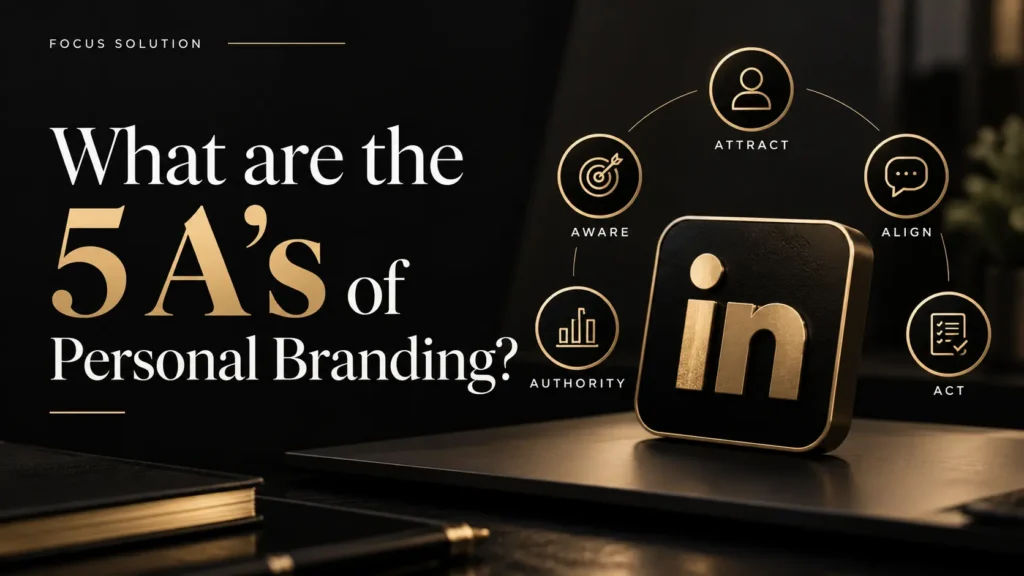
The 5 A’s of personal branding give you a simple way to manage that reality on purpose instead of leaving it to chance. The framework covers awareness, authority, authenticity, appearance, and audience. Each one answers a different question about how you show up professionally.
This guide walks through all five with real data, practical steps, and common mistakes to avoid. By the end, you’ll have a clear checklist you can start applying this week.
What Are the 5 A’s of Personal Branding?
The 5 A’s of personal branding are Awareness, Authority, Authenticity, Appearance, and Audience. Together, they describe how well you understand your reputation, prove your expertise, stay true to yourself, present yourself, and reach the right people.
One honest note: there is no single official version of this framework. Some coaches swap in terms like action, adaptation, or accountability. The Awareness, Authority, Authenticity, Appearance, and Audience version is the one that appears most often in search results, so that’s the one used here.
| The A | The question it answers | Quick action |
| Awareness | How do people see me right now? | Audit your online presence |
| Authority | Why should people trust my expertise? | Publish useful, specific insights |
| Authenticity | Does my brand match who I really am? | Build on real strengths and values |
| Appearance | What does my first impression say? | Polish your photo, bio, and profiles |
| Audience | Who exactly am I trying to reach? | Define one core reader or client |
The order matters. You can’t build authority in a vacuum, and you can’t pick an audience until you know what you stand for. Let’s start where every strong personal brand starts.
Awareness: Know How People See You Today
Awareness means understanding how others currently perceive you, and why. Most professionals skip this step. They jump straight to posting content without checking what their existing footprint already says.
The stakes are real. A CareerBuilder survey conducted by The Harris Poll found that 70% of employers use social media networking sites to research job candidates (CareerBuilder, 2018). Of the employers who do that research, 57% found content that made them pass on a candidate (CareerBuilder, 2018).
In other words, people are already forming opinions about you online. The only question is whether you know what they’re finding.
How to Run a Quick Perception Audit
You don’t need special tools. Set aside 30 minutes and work through this list:
• Google yourself in a private browser window and note the first page of results.
• Review your LinkedIn headline and summary. Do they say what you actually do and for whom?
• Check old posts and tagged photos on public profiles.
• Ask three colleagues or clients to describe you in three words. Compare their answers with how you’d describe yourself.
That last step often delivers the biggest surprise. The gap between how you see yourself and how others see you is where your branding work lives.
Authority: Become the Trusted Voice in Your Niche
Authority is the proof behind your claims. It’s what turns “I’m good at this” into “people consistently turn to me for this.”
The business case is strong. In the 2024 Edelman-LinkedIn B2B Thought Leadership Impact Report, which surveyed 3,484 business leaders, 73% of decision-makers said an organization’s thought leadership is a more trustworthy basis for judging its capabilities than its marketing materials (Edelman & LinkedIn, 2024). The same report found that 60% of decision-makers are willing to pay a premium to organizations that offer valuable thought leadership (Edelman & LinkedIn, 2024).
That research looks at organizations, but the logic carries over to individuals. People trust useful insight more than self-promotion.
Practical Ways to Build Authority
• Pick a narrow topic and go deep. Being known for one thing beats being vaguely known for ten.
• Share specific experience. Walk through a project, a mistake, or a lesson with real details.
• Back claims with data. Decision-makers in the Edelman-LinkedIn study rated research-backed content as a mark of quality thought leadership (Edelman & LinkedIn, 2024).
• Publish consistently on the platform where your audience actually spends time, whether that’s LinkedIn, a blog, or a newsletter.
• Collect proof. Testimonials, case studies, talks, and certifications all strengthen your credibility.
Common Authority Mistake
The most common error is summarizing what everyone else already says. If your post could appear under anyone’s name, it won’t build authority. Add your own experience, your own numbers, or your own opinion.
Authenticity: Build on What’s Actually True About You
Authenticity means your brand reflects your real strengths, values, and way of working. It sounds obvious, but it’s the A that people most often lose when they start copying a popular creator or an admired executive.
Here’s a practical way to think about it. A brand built on a borrowed persona is hard to maintain. You’ll have to remember the act in every meeting, every post, and every conversation.
A Simple Test for Authenticity
Before you publish a post, update a bio, or adopt a new tagline, run it through three checks:
• Is it true? Could you back it up if someone asked you about it in person?
• Does it sound like me? Read it aloud. If you’d never say it, rewrite it.
• Does it reflect what I value? Your brand should point at the work you actually want more of.
Authenticity doesn’t mean sharing everything. You choose what to share. It means that whatever you share is honest and consistent with who you are.
Authenticity in Practice
Imagine two freelance consultants who both specialize in operations. One posts generic productivity tips borrowed from popular accounts.The second consultant is easier to remember, easier to trust, and easier to refer. That’s authenticity doing real work.
Appearance: Make Your First Impression Count
Appearance covers the visual and verbal packaging of your brand: your profile photo optimize, your bio, your website design, your writing style, and how you present yourself in person and on video.
Research from Princeton University shows how fast this works. In a series of experiments, Willis and Todorov found that judgments of attractiveness, likeability, trustworthiness, competence, and aggressiveness formed after just 100 milliseconds of exposure to a face correlated strongly with judgments made with no time limit (Willis & Todorov, 2006)
That doesn’t mean first impressions can’t change. It does mean you’ll want to make the first one count.
Appearance Checklist for Professionals
• Profile photo: A clear, well-lit, recent headshot where your face is easy to see.
• Headline and bio: State what you do, who you help, and one proof point.
• Visual consistency: The same photo, name, and tone across LinkedIn, your website, and speaker profiles.
• Writing style: Keep it clear and human. Short sentences usually beat jargon.
• Professional details: Check screen names, email addresses, and links. The CareerBuilder survey found that employers cited an unprofessional screen name as a reason not to hire for 22% of candidates they rejected (CareerBuilder, 2018).
Appearance supports the other A’s. A strong photo won’t save weak content, but weak packaging can hide strong expertise.
Audience: Show Up for the Right People
Audience is about knowing exactly who your brand is for. A personal brand that speaks to everyone usually connects with no one.
Building an audience takes patience, and the data explains why. According to the 2024 Edelman-LinkedIn report, at any given time roughly 95% of business buyers aren’t actively in the market (Edelman & LinkedIn, 2024).
Attention is available too. The same report found that 52% of decision-makers and 54% of C-suite executives spend an hour or more per week reading thought leadership content (Edelman & LinkedIn, 2024).
How to Define Your Audience
1. Describe one specific person. Include their role, their biggest problem, and where they spend time online.
2. List their top three questions. These become your content topics.
3. Choose one or two platforms. Depth on two channels beats a thin presence on six.
4. Engage, don’t just broadcast. Comment on their posts, answer questions, and start conversations.
5. Review every quarter. Check who is actually reading, sharing, and replying, then adjust.
Common Audience Mistake
Many professionals chase follower counts. Follower count tells you little. Ten decision-makers who know exactly what you do are worth more than a thousand passive followers.
How the 5 A’s Work Together
The five elements reinforce each other. Awareness shows you where you stand. Authenticity ensures you build on solid ground. Authority proves your value, appearance packages it clearly, and audience makes sure the right people see it.
A practical sequence for the next 30 days:
A Complete your perception audit (Awareness).
Clarify your values and strengths, then rewrite your headline and bio (Authenticity and Appearance).
Define your core reader and outline three content topics (Audience).
Publish your first piece with a real story and one verified data point (Authority).
Then repeat. Personal branding is an ongoing process, not a one-time project.
Conclusion
The 5 A’s of personal branding give you a clear, repeatable structure: know how you’re seen, prove your expertise, stay true to yourself, present yourself well, and speak to the right people. Skip one, and the others work harder to compensate. Combine all five, and your reputation starts doing some of the selling for you.
Start small. Run the perception audit this week, fix one weak spot, and publish one useful post. Ready to put the framework to work? Pick the A you’ve neglected most and take one action on it today.