
The 4 Types of LinkedIn Content Every Expert Brand Needs
LinkedIn now counts more than 1.3 billion professionals among its members worldwide, and roughly a third of American adults say they use the platform (Statista, 2026; Pew Research Center, 2025). That is an enormous, built in audience of buyers, hiring managers, and decision makers, all scrolling through the same feed every day, actively looking for people worth following.
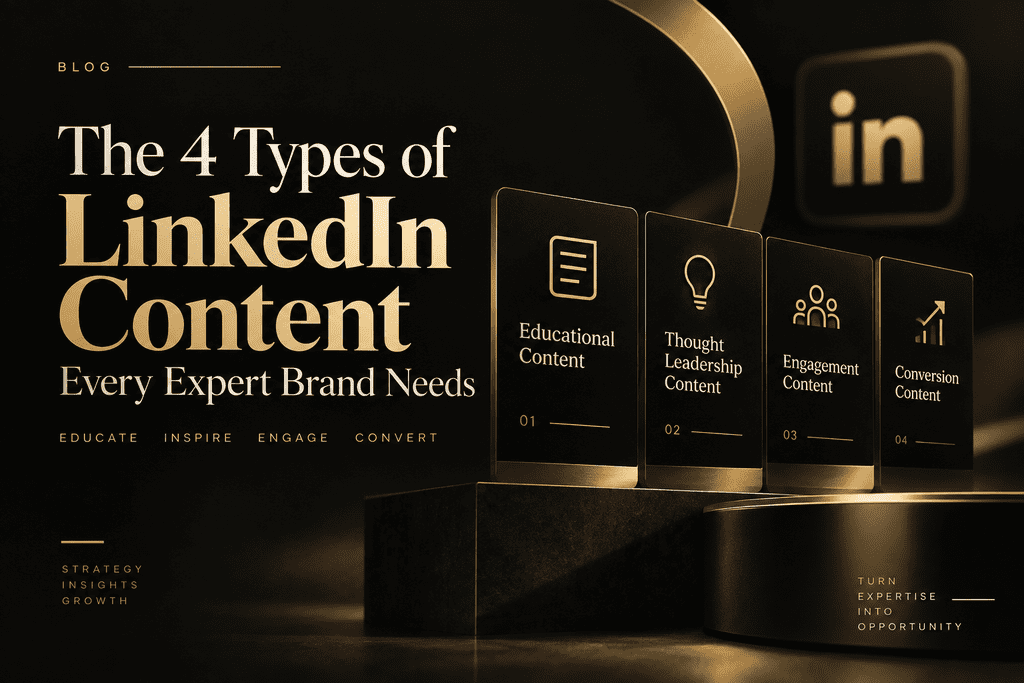
Yet most people who show up on LinkedIn treat it like a bulletin board. They post when they remember to, share whatever crosses their mind that morning, and hope something sticks. An expert brand cannot run on hope. It needs a repeatable mix of LinkedIn content types that each do a different job: proving expertise, teaching something useful, building trust as a person, and showing real world results.
This guide breaks down the four LinkedIn content types that consistently separate credible, in demand experts from everyone else who is simply posting. You will learn what each type looks like, why it works, and how to weave all four into a rhythm you can actually sustain.
Why “Post and Hope” Is Not a LinkedIn Content Strategy
Almost every B2B marketing team says it has a content strategy on paper. In its newest annual benchmark study of 1,015 B2B marketers, Content Marketing Institute found that the large majority operate from some kind of documented plan, yet only 59 percent rate their content marketing as even somewhat effective (Content Marketing Institute, 2026). Having a plan and having a plan that works are two very different things.
The same gap shows up on individual LinkedIn profiles. Plenty of professionals post consistently, but their content is a grab bag of quotes, congratulations posts, and the occasional hot take. Nothing builds on anything else, so a visitor never gets a clear sense of what that person actually knows or does for a living.
The fix is not posting more often. It is posting with intention, using a small set of LinkedIn content types that each serve a distinct purpose. Understanding these four content types is the fastest way to turn a scattered posting habit into a real LinkedIn content strategy.
LinkedIn Content Type 1: Thought Leadership Posts
What Thought Leadership Content Looks Like
Thought leadership content shares your point of view on a trend, a mistake, or a shift happening in your industry. It might challenge a common assumption, break down why a popular tactic is failing, or explain a pattern you keep seeing with clients. The goal is not to inform in a neutral, textbook way. It is to show how you think.
Why Decision Makers Reward It
This content type carries real commercial weight. Seventy three percent of B2B decision makers say an organization’s thought leadership is a more trustworthy basis for judging its capabilities than its marketing materials, and 60 percent say strong thought leadership makes them willing to pay a premium to that supplier (Edelman & LinkedIn, 2024). That is not a soft branding benefit. It is a direct line to pricing power.
For an expert brand, every well argued opinion post is doing double duty. It builds a reputation, and it quietly earns the kind of trust that a sales pitch never could.
Try this prompt this week: think of the last piece of advice you disagreed with in your field, then write three sentences on what you would tell a client instead, and why.
LinkedIn Content Type 2: Educational, How To Content
Turning Expertise Into a Usable Framework
Educational content teaches something the reader can use right away: a three step process, a short checklist, a way to evaluate a vendor, or a framework for making a decision. It is the content type most likely to get saved, screenshotted, and shared with a colleague, because it has immediate, practical value.
Why Buyers Reward Teaching Content
Teaching content also meets buyers where they actually are. McKinsey’s research on B2B buying behavior found that buyers now consult roughly ten different channels before making a purchase decision, more than double the number from just a few years earlier (McKinsey & Company, 2022). A short LinkedIn post that walks through how to solve a specific problem can be one of those ten touchpoints, showing up in someone’s research long before they are ready for a sales conversation.
The best educational posts are narrow, not broad. A specific framework for one recurring problem will outperform a generic list of best practices every time, because it proves you have actually solved that exact problem before.
Try this prompt this week: pick one question you answer for clients almost every week, and turn your usual answer into a numbered, three step post.
LinkedIn Content Type 3: Personal Story and Behind the Scenes Content
Why Authenticity Outperforms Polish
Personal story content shows the human being behind the expertise: a career turning point, a mistake that taught you something, or a behind the scenes look at how a project actually came together. It is the content type most likely to earn real comments instead of silent likes, because people respond to people, not to a polished brand voice.
What the Research Says About Personal Branding
Harvard Business Review’s research on personal branding frames this well. A credible personal brand rests on three things: your credentials, your social capital, meaning the strength of your professional relationships, and your cultural capital, meaning the judgment and perspective you have built through lived experience (Avery & Greenwald, Harvard Business Review, 2023). Credentials alone rarely make someone memorable. The story around them does.
A well told personal story does not need to be dramatic. It needs to be true, specific, and tied back to a lesson the reader can actually use in their own work.
Try this prompt this week: describe a moment early in your career when you got something wrong, and the one thing it taught you that you still use today.
LinkedIn Content Type 4: Social Proof and Case Study Content
Turning Results Into Content
Social proof content turns a result into a story: a before and after, a client outcome, a short testimonial, or a breakdown of how a specific problem got solved. Where thought leadership builds trust in your thinking, proof content builds trust in your delivery.
How Proof Content Moves Deals Forward
This content type has a direct line to revenue. Seventy nine percent of B2B decision makers say they are more likely to advocate for a vendor during the RFP process when that vendor consistently produces high quality thought leadership (Edelman & LinkedIn, 2025). The proof and results posts you publish today are doing groundwork for deals that may not close for months.
The most effective proof posts do not just state a number. They walk through the specific decision or approach that produced it, so the story still teaches something even to a reader who was never going to buy.
Try this prompt this week: pick one client win from the last quarter and write three sentences on the single decision that made the biggest difference.
Turning the 4 LinkedIn Content Types Into a Weekly Rhythm
You do not need to post every single day to build an expert brand on LinkedIn. You need a rhythm that touches all four LinkedIn content types over a few weeks, so your profile reflects a full picture of what you think, what you know, who you are, and what you have delivered.
A simple starting cadence looks like this, spread across two to three weeks:
• One thought leadership post making a clear, specific argument
• One educational post teaching a narrow, usable framework
• One personal story post that adds context to your expertise
• One proof post showing a real, specific client result
Rotate the order based on what is actually happening in your business or industry that week. The point is not to hit a quota. It is to make sure that anyone who lands on your profile, whether after one post or twenty, walks away with a rounded sense of what you know, how you think, and why they should trust you with the work.
Key Takeaways
An expert brand on LinkedIn is not built by one viral post. It is built by consistently showing up across four LinkedIn content types: thought leadership that proves how you think, educational content that proves what you know, personal stories that prove who you are, and social proof that proves what you deliver. Miss one of the four, and your profile tells an incomplete story.
Start small. Look back at your last ten posts and sort them into these four categories. Wherever you find an empty category, that is your next post idea.
Staying consistent across all four LinkedIn content types every single week, in a voice that still sounds like you, is where most busy professionals fall off. If that sounds like your week, our ghostwriting services are built for exactly this gap. We turn your expertise into a steady stream of thought leadership, educational, personal, and proof based posts, written in your voice, so your LinkedIn presence keeps compounding even on your busiest weeks.


